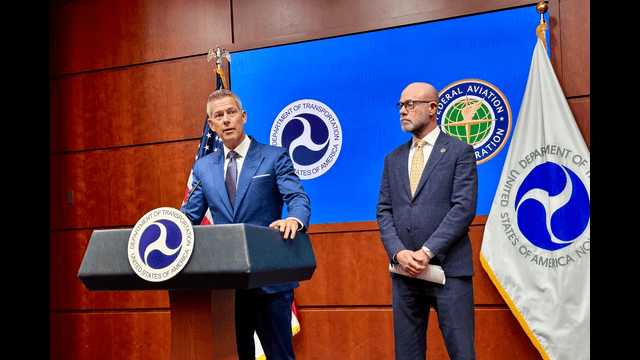
Transportation Secretary Sean Duffy, left, speaks at a news conference with FAA administrator Bryan Bedford to announce flight cancellations across the country because of the government shutdown, Wednesday, Nov. 5, 202,5, at the U.S. Department of Transportation headquarters in Washington.
The Federal Aviation Administration (FAA) has announced a 10% reduction in air traffic across 40 major U.S. markets, starting Friday morning. The move comes amid growing stress among air traffic controllers who have been working without pay since the government shutdown began on October 1.
FAA officials said the temporary reduction aims to maintain travel safety as staffing shortages and fatigue among controllers worsen. The cut is expected to affect thousands of daily flights nationwide, including commercial, cargo, and private aircraft.
FAA Administrator Bryan Bedford called the measure “extraordinary,” noting that it’s unprecedented in his 35 years in aviation. “We’re taking these steps to ensure safety before the system reaches a crisis point,” Bedford said.
Controller Fatigue Forces Action
Air traffic controllers have been putting in long hours — often six days a week — without pay. Many have taken second jobs or missed shifts due to financial strain. This has caused delays at several major airports.
Bedford said voluntary safety reports from pilots indicate that controller fatigue is growing. He emphasized that the FAA and Transportation Secretary Sean Duffy acted early to prevent potential safety risks.
“We’re not waiting for a tragedy,” Bedford said. “The system remains safe, but we must act now to keep it that way.”
Airlines Brace for Impact
The FAA will meet with airline executives to finalize the list of affected airports. United, Southwest, and American Airlines said they are working to minimize disruptions for passengers.
United Airlines CEO Scott Kirby told employees the airline will focus cuts on regional and non-hub routes. Long-haul and hub-to-hub flights will remain unaffected. Customers will be offered rescheduling options or refunds.
“Our goal is to protect core operations and give customers flexibility,” Kirby said.
Despite the announcement, customer service hotlines reported manageable call volumes Wednesday afternoon, suggesting travelers were not yet panicking.
Analysts Warn of Scheduling Chaos
Industry experts criticized the short notice given to airlines. Henry Harteveldt, president of Atmosphere Research Group, said the FAA’s decision could create confusion.
“Rebuilding flight schedules in 48 hours is unrealistic,” Harteveldt said. “It will cause chaos for airlines and passengers.” He added that the move might be intended to pressure political leaders to resolve the shutdown.
Travel experts advised passengers to stay updated via airline apps and airport social media channels. “There’s not much travelers can do,” said AAA spokesperson Aixa Diaz. “You either fly or you don’t.”
Thousands of Flights Affected
According to aviation analytics firm Cirium, the 10% reduction could eliminate up to 1,800 flights and 268,000 passenger seats in a single day. If applied evenly, Chicago O’Hare could lose 121 flights out of its 1,212 scheduled departures on Friday.
The FAA regularly adjusts flight schedules for weather or equipment issues. But this reduction, driven by staffing shortages, marks one of the most significant disruptions since the shutdown began.
Staffing Shortages Worsen
An Associated Press review found that from Friday to Sunday, at least 39 control facilities reported potential staffing shortages — far above the pre-shutdown average of eight per weekend.
Since October 1, that figure has tripled, averaging 26 facilities each weekend. FAA officials warn that without relief, these shortages could cause further slowdowns or temporary closures at busy airports.
Travel Industry Calls for Shutdown’s End
Airlines, unions, and travel groups have renewed their plea for Congress to end the shutdown, warning that continued strain on aviation workers could threaten both safety and reliability.
Transportation Secretary Sean Duffy echoed these concerns, recalling how a deadly midair collision earlier this year prompted questions about FAA inaction.
“We learned from that,” Duffy said. “Now, we act before small issues turn into tragedies.”
As the shutdown continues, travelers face uncertainty — and the nation’s aviation system faces one of its biggest operational tests in decades.