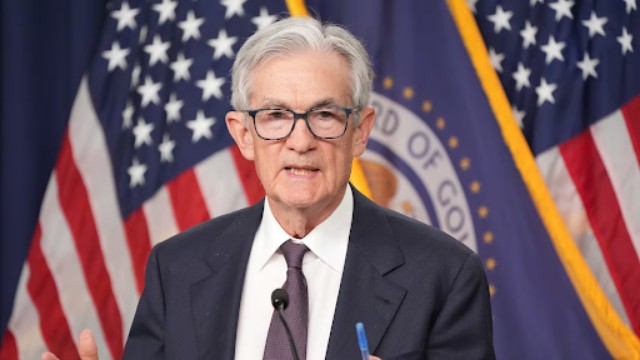
Federal Reserve Chair Jerome Powell spoke at a press conference on Wednesday, May 7, 2025, in Washington, following the latest meeting of the Federal Open Market Committee. The event was held at the Federal Reserve’s headquarters. (Photo: Jacquelyn Martin/AP)
In its latest move, the U.S. Federal Reserve has chosen to leave its key interest rate unchanged at 4.3% for the third consecutive time, despite growing concerns over both rising prices and job losses. This decision puts the central bank in a delicate position as it tries to steer the U.S. economy through unpredictable waters stirred up by ongoing trade tensions and global uncertainty.
The announcement came even as President Donald Trump continued to push for lower borrowing rates. But Fed Chair Jerome Powell made it clear that political pressure won't shape their decisions. "We’re always going to consider only the economic data, the outlook, and the balance of risks," Powell said during a press conference.
What’s troubling economists and policymakers alike is the unusual mix of economic risks: inflation is still hovering near the Fed’s 2% target, yet unemployment concerns are growing. That’s because President Trump’s wide-ranging tariffs—especially those targeting China—have created a ripple effect, raising costs for American companies and threatening future hiring.
Powell acknowledged the challenge: if the tariffs stay in place or increase, inflation could jump while growth slows and unemployment ticks up. "There's just so much that we don't know," he admitted, signalling a wait-and-see approach to any future rate changes.
The uncertainty is especially intense around how long the price hikes from tariffs might last. Economists generally expect a short-term spike, but if new tariffs hit industries like medicine, technology, or raw materials—as Trump has warned—they could lead to more sustained inflation.
The Fed typically fights inflation by raising interest rates and supports job growth by cutting them. But with both risks rising at once, the bank faces a tough call. “Depending on how things play out, it could include rate cuts, or us holding where we are,” Powell said.
Adding fuel to the fire is Trump’s strained relationship with Powell. In a recent TV interview, the president suggested Powell disliked him personally and repeated his call for rate cuts. While Trump said he wouldn’t remove Powell—whose term ends next May—he left open the door for further criticism if the economy slows down.
Despite the pressure, most analysts think a rate cut isn’t likely until at least September. Krishna Guha, an economist at Evercore ISI, noted that the Fed's current stance indicates no urgency to adjust rates before then. The central bank, he said, appears to be signalling confidence in the economy's overall strength for now.
Still, the threat of inflation is growing. Manufacturing and service industries are already seeing higher costs from suppliers, and more than half of manufacturers plan to pass those costs on to consumers, according to a Federal Reserve survey from Dallas.
Economists like Torsten Slok of Apollo Group predict that prices will likely rise in the next six months. If inflation expectations among consumers grow, that alone could lead to even higher prices, as people adjust their behaviour—such as demanding bigger paychecks or rushing to buy big-ticket items before costs rise further.
While the economy remains relatively stable—with steady hiring and consumer spending—many companies are holding off on investment and financial forecasts until they get a clearer picture. The uncertainty created by the tariffs, rather than immediate damage, may be the biggest obstacle ahead.