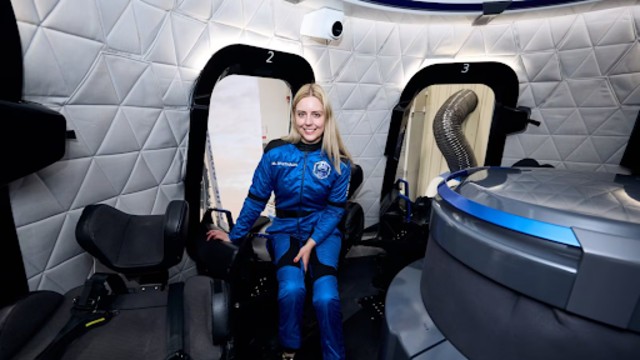
This photo provided by Blue Origin shows Michaela Benthaus, a German engineer aiming to become the first wheelchair user in space, sitting in a capsule mockup Monday, Dec. 15, 2025, at Blue Origin’s rocket launch site in Van Horn, Texas. (Blue Origin via AP)
A German engineer has shattered barriers in spaceflight, becoming the first wheelchair user to travel to space and experience weightlessness.
Michaela Benthaus, 33, blasted off Saturday aboard a Blue Origin rocket from West Texas, leaving her wheelchair behind on Earth and floating freely above the planet she once thought she would never see from space.
A Milestone Moment In Private Spaceflight
Benthaus, who was left paraplegic after a mountain biking accident seven years ago, joined five other passengers on the 10-minute suborbital flight aboard Blue Origin’s New Shepard capsule.
The mission marked a historic first. No wheelchair user had ever flown to space before.
“It was the coolest experience,” Benthaus said after landing. “I laughed all the way up and even tried to turn upside down.”
Designed With Accessibility In Mind
Blue Origin said only minor adjustments were needed to accommodate Benthaus. The autonomous capsule was already built with accessibility features, including an elevator at the launch pad and a spacious cabin.
To assist Benthaus, engineers added a transfer board to help her move between the capsule hatch and her seat. After landing, recovery crews rolled out a carpet across the desert floor so she could immediately access her wheelchair.
“She did as much as possible on her own,” said Blue Origin engineer Jake Mills, who trained the crew.
Supported By A Fellow Engineer
Benthaus flew alongside Hans Koenigsmann, a retired SpaceX executive born in Germany, who helped organize and sponsor her flight. He was also designated her emergency helper and assisted her after touchdown.
Ticket prices for the private mission were not disclosed.
From Uncertainty To Zero Gravity
Benthaus is part of the European Space Agency’s graduate trainee program in the Netherlands. Before her accident, she never imagined spaceflight would be realistic, even for someone without a disability.
“There is no history of people with disabilities flying to space,” she said before the mission.
She first experienced weightlessness during a parabolic flight in 2022 and later took part in a simulated space mission in Poland. When Koenigsmann approached her last year with the idea of flying on Blue Origin, she initially thought there had been a misunderstanding.
There wasn’t.
A Broader Message Beyond Space
The mission was independent of ESA, though the agency recently cleared reserve astronaut John McFall, an amputee, for a future International Space Station mission.
Benthaus hopes her journey sends a wider message.
“You should never give up on your dreams,” she said after landing.
She believes accessibility should extend beyond spaceflight and into everyday life on Earth.
“I hope I’m only the start,” she said.
Blue Origin’s Growing Passenger List
Benthaus and her crewmates raised Blue Origin’s total number of space travelers to 86. Past passengers have included people with limited mobility, sensory impairments, and even travelers in their 90s.
Founded by Jeff Bezos in 2000, Blue Origin launched its first human spaceflight in 2021 and continues to expand its ambitions, including lunar landers and orbital missions.
For Benthaus, however, the mission’s impact is already clear.
The sky, she proved, is no longer a limit.