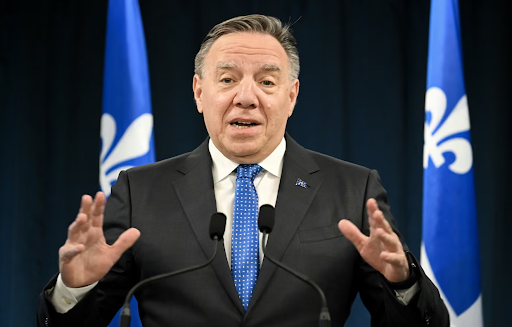
François Legault, Quebec’s premier, speaks to reporters during a news conference in Montreal on March 15, 2024. Getty Images
Quebec Premier François Legault announced his resignation on Wednesday, stunning the province and reshaping the political landscape just months before a scheduled election.
Legault made the announcement at a quickly arranged news conference in Quebec City. He said he felt proud of his time in office and of founding the Coalition Avenir Québec, which formed government in 2018 and won a second majority in 2022.
“Serving as premier was the greatest honour of my life,” he said, as supporters applauded.
Staying on until a new leader is chosen
Legault will remain premier until his party selects a new leader, a process that could take several months. This timing places added pressure on the CAQ, which now faces a November provincial election with little time to regroup.
The resignation comes after months of growing instability within the government. Several senior ministers and close allies stepped aside, while public support for the party dropped sharply. Recent polling suggested the CAQ could face a near-total collapse in the next election.
A government under heavy strain
Legault’s government struggled with several high-profile controversies. One major issue involved changes to how doctors receive pay in Quebec. The backlash forced Health Minister Christian Dubé to resign, weakening the government’s standing in the health sector.
Another major problem centred on a troubled digital system for driver’s licences and vehicle registration. Costs climbed into the hundreds of millions of dollars, triggering a public inquiry. Cybersecurity Minister Éric Caire resigned in February 2025 after pressure mounted.
Debates over secularism and language
Beyond administrative challenges, the CAQ often sparked debate over social and cultural issues. The government pushed strict secular policies, including a plan announced last August to ban public prayer. Civil rights groups warned the move unfairly targeted religious minorities.
Earlier, in 2019, the government passed Bill 21, which barred certain public workers from wearing religious symbols at work. The law drew legal challenges and criticism across Canada.
Language protection also stood at the centre of Legault’s agenda. His government strengthened French-language rules in public life. In 2022, Legault said he felt “proud to be a francophone nation in North America” and called it the government’s duty to protect French.
Immigration tensions and sharp remarks
Legault often clashed with Ottawa over immigration and asylum claims. As Quebec received a rise in asylum seekers, many from Haiti, his government argued the province lacked the capacity to respond.
“The problem isn’t the Haitians, it’s not the immigrants, it’s the number,” Legault said earlier this year. During his resignation remarks, he added that Quebecers “must not be embarrassed about protecting our values.”
A shifting political field
Legault’s exit follows another recent leadership shake-up. Quebec Liberal leader Pablo Rodriguez resigned earlier this year amid allegations tied to his leadership race, which he denied.
With both major parties searching for new leaders, the Parti Québécois now leads provincial polls. Party leader Paul St-Pierre Plamondon has promised to hold a new referendum on Quebec sovereignty if his party wins the election.