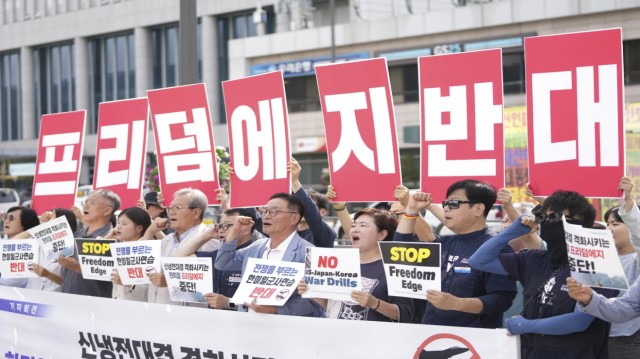
Protesters shout during a conference to oppose the military exercise called Freedom Edge in Seoul, South Korea, Monday, Sept 15, 2025.
The United States, South Korea, and Japan have begun a large-scale joint air and naval drill near South Korea’s Jeju Island. The exercise, named Freedom Edge, started Monday and will continue through Friday.
It marks one of the most advanced trilateral defense collaborations to date, according to the U.S. Indo-Pacific Command. The operation is designed to showcase combined strength in air, sea, and cyberspace.
But the move has already drawn sharp criticism from North Korea.
Freedom Edge: A Joint Push for Stronger Defense
The South Korean Defense Ministry stated that Freedom Edge aims to boost operational readiness against North Korea’s expanding nuclear and missile capabilities.
The exercise includes U.S. Marine and Air Force assets, advanced ballistic missile drills, and enhanced air-defense systems. Medical evacuation and maritime training also form part of the operation.
Officials describe it as the most advanced demonstration of U.S.-South Korea-Japan defense cooperation so far.
North Korea Calls Drills a “Reckless Show of Strength”
North Korea reacted quickly. Kim Yo Jong, the influential sister of leader Kim Jong Un, condemned the drill in state media.
She accused the three nations of taking a hostile stance toward Pyongyang. Her warning was direct: “This reckless show of strength in the wrong place will bring bad results.”
Kim also attacked the U.S. and South Korea over their recent Iron Mace tabletop exercise, which explores integrating U.S. nuclear capabilities with South Korea’s conventional forces. While officials did not confirm if it overlapped with Freedom Edge, reports suggest both exercises are running simultaneously.
History of Tensions Over Military Exercises
North Korea has a long history of opposing such joint drills. Pyongyang often views them as rehearsals for invasion and has responded in the past with missile tests and military demonstrations.
Despite repeated offers from Washington and Seoul to restart negotiations, Kim Jong Un’s regime has refused. Instead, North Korea continues to advance its weapons programs and strengthen ties with allies opposed to the United States.
Kim Jong Un’s Strategic Shift Toward Russia and China
As diplomatic talks remain stalled, Kim Jong Un has turned outward. His government is actively deepening military and political relations with Russia and China.
Since Russia’s invasion of Ukraine, North Korea has sent artillery, missiles, and troops to aid Moscow’s war effort. Kim’s support for Vladimir Putin highlights his strategy of aligning with nations confronting the West.
Earlier this month, Kim traveled to China. He stood alongside President Xi Jinping and President Putin during a major military parade, signaling a stronger trilateral bond. These moves are widely seen as efforts to increase his bargaining power against Washington and Seoul.
Rising Regional Tensions
The Freedom Edge exercise underscores the growing military cooperation between the United States, South Korea, and Japan. Yet, it also heightens tensions with Pyongyang, which continues to reject dialogue and strengthen ties with Moscow and Beijing.
As the drills progress off Jeju Island, the situation reflects a delicate balance of deterrence and provocation in Northeast Asia. The next steps—whether further military responses from North Korea or renewed diplomatic pushes—remain uncertain.