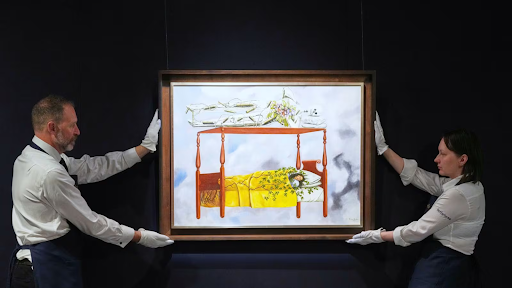
A Frida Kahlo painting titled El sueño (La cama), also known as The Dream (The Bed), sits on display at an auction gallery in London on Sept. 19, 2025. AP Photo
A striking self-portrait by celebrated Mexican painter Frida Kahlo now holds a new place in art history. Her 1940 work, El sueño (La cama) — known in English as The Dream (The Bed) — sold for US$54.7 million on Thursday. The sale took place in New York and set a new auction record for any artwork created by a woman.
The price also surpassed the previous record held by Georgia O’Keeffe’s Jimson Weed/White Flower No. 1, which sold for US$44.4 million in 2014. Kahlo’s new record highlights her growing global influence and the rising value of her rare works.
Kahlo Breaks Her Own Latin American Record
The sale not only topped the highest figure for a female artist but also broke Kahlo’s own auction record. Her 1949 painting Diego and I, which portrayed her complex relationship with her husband, Diego Rivera, sold for US$34.9 million in 2021. Some private sales of Kahlo’s work have reportedly reached even higher prices.
Only a small number of Kahlo’s paintings remain in private hands. Mexico declared her body of work an artistic monument, which means pieces located within the country cannot be legally sold abroad or destroyed. The portrait sold Thursday came from a private collection outside Mexico and met the legal conditions for global sale. The seller’s identity remains confidential.
Debate Around Cultural Loss and Public Access
Some art historians expressed concern that the painting may once again vanish from public view. Its last public exhibition took place in the late 1990s. Institutions in New York, London and Brussels have already requested to display the piece in upcoming shows, hoping to keep the work accessible. The buyer has not been identified.
The painting shows Kahlo asleep in a carved wooden bed floating among clouds. She wears a gold blanket as vines and leaves wrap around her body. Above her rests a skeletal figure holding sticks of dynamite. The haunting image reflects themes Kahlo explored during years of physical pain and long periods spent bedridden.
A Life Marked by Pain and Artistic Clarity
Kahlo painted with raw honesty. A bus accident at age 18 left her with severe injuries. She endured many surgeries, wore casts for long periods and lived with constant pain. She began painting while confined to her bed and often used her body and her emotional world as her subjects.
During her immobility, the bed became a powerful symbol. She saw it as a place between life and death, where she confronted her fears and her own fragility. These themes appear throughout her self-portraits, which remain among the most recognizable images in modern art.
Her great-niece, Mara Romeo Kahlo, spoke about the sale in a recent interview in Mexico City. “I’m very proud that she’s one of the most valued women, because really, what woman doesn’t identify with Frida, or what person doesn’t?” she said. “I think everyone carries a little piece of my aunt in their heart.”
A Standout Piece in a Surrealist Collection
The painting was the highlight of an auction featuring more than 100 surrealist works by artists such as Salvador Dalí, René Magritte, Max Ernst and Dorothea Tanning. Kahlo often rejected the surrealist label, even though many people saw her dreamlike images as part of that movement.
“I never painted dreams,” she once said. “I painted my own reality.”
The auction house described the painting as a powerful reflection on “the porous boundary between sleep and death.” It noted that the skeleton above the bed “is often interpreted as a visualization of her anxiety about dying in her sleep,” a feeling shaped by her long history of pain and trauma.