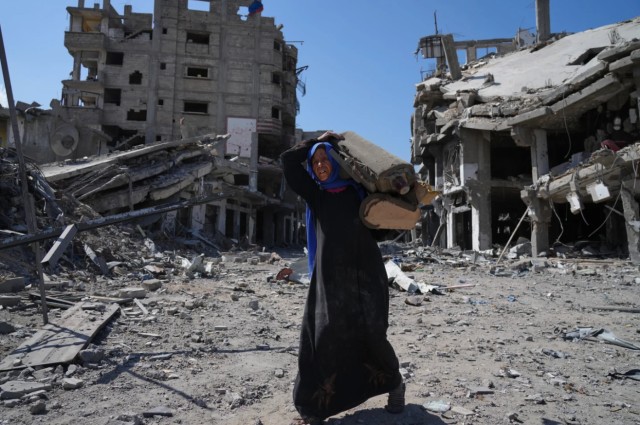
An elderly displaced Palestinian woman carries an item past destroyed buildings in Khan Younis, southern Gaza Strip, Friday, Oct. 10, 2025, after Israel and Hamas agreed to a pause in their war and the release of the remaining hostages.
Tens of thousands of Palestinians made their way back to the shattered northern Gaza Strip on Friday, hours after a U.S.-brokered Gaza ceasefire came into effect. The truce has raised cautious hopes of ending the two-year-long Israel-Hamas war, though uncertainty lingers over Gaza’s future governance and Hamas’ disarmament.
A Fragile Calm Returns
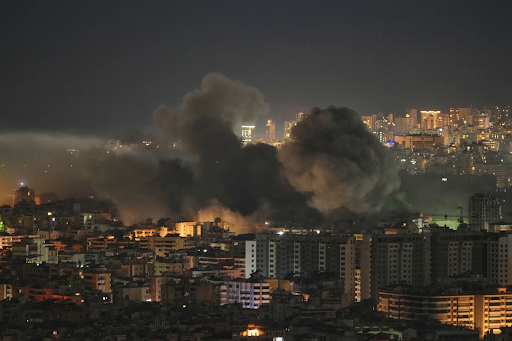
For the first time in months, heavy shelling and airstrikes subsided across much of Gaza. Israel’s military confirmed the ceasefire had begun, marking what many see as a potential turning point in one of the region’s most destructive conflicts.
Under the agreement, all remaining hostages—48 in total, including about 20 believed to be alive—are to be released by Monday. Israeli Prime Minister Benjamin Netanyahu warned that Israel would resume its offensive if Hamas refused to surrender its weapons.
“If this is achieved the easy way — so be it. If not — it will be achieved the hard way,” Netanyahu said in a televised statement.
Despite his warning, the ceasefire signals progress toward ending a devastating war that began in October 2023, after Hamas launched a deadly attack on Israel.
Gaza in Ruins
Returning Palestinians were met with scenes of near-total destruction. The war has displaced about 90% of Gaza’s population of two million and killed tens of thousands. Many who returned found only rubble where their homes once stood.
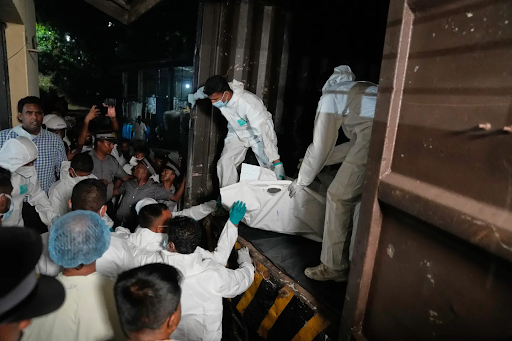
In the southern city of Khan Younis, residents found entire neighborhoods flattened. “There was nothing left — just a few clothes, pieces of wood, and pots,” said Fatma Radwan, one of the displaced residents. Others were still retrieving bodies from beneath the ruins.
Hani Omran, another resident, described the devastation starkly: “We came to a place that is unidentifiable. Destruction is everywhere.”
Aid Shipments to Begin Sunday
The United Nations has been cleared by Israel to begin large-scale aid deliveries to Gaza starting Sunday. A U.N. official confirmed that 170,000 metric tons of food, fuel, and medical supplies are ready for transport from Jordan and Egypt.
This aid aims to counter widespread hunger and malnutrition caused by Israeli blockades and fighting. The International Criminal Court (ICC) has sought the arrest of Netanyahu and his former defense minister over allegations of using starvation as a weapon of war — claims Israel denies.
U.N. spokesperson Stephane Dujarric said supplies have already begun moving through the Kerem Shalom crossing. However, the U.N. continues to urge Israel to open more border points and guarantee safe access for humanitarian workers and civilians.
So far, humanitarian organizations have been able to deliver only 20% of the required aid, according to U.N. humanitarian chief Tom Fletcher.
Human Struggle Amid Hope
As the ceasefire took hold, long lines of Palestinians — most traveling on foot — moved north through the coastal road to inspect what remained of their neighborhoods. The emotional scene echoed earlier ceasefires but with even deeper scars this time.
“There wasn’t much joy, but the ceasefire somewhat eased the pain,” said Jamal Mesbah, displaced from northern Gaza. “It gave us a small sense of relief after endless death and destruction.”
Prisoner and Hostage Exchange
Israel has agreed to release around 2,000 Palestinian prisoners in exchange for the hostages. The deal excludes high-profile detainees like Marwan Barghouti, a popular Palestinian political figure.
Hamas official Khalil al-Hayya announced that all women and children in Israeli jails will be freed under the agreement. The exchanges are expected to begin as early as Sunday night, though officials have not confirmed the exact schedule.
For the families of Israeli hostages, the ceasefire offers mixed emotions. “It’s a measured sense of hope,” said Stephen Brisley, whose relatives were among the victims of Hamas’ October 7 attack. “We hold our hope lightly because we’ve had it dashed before.”
The Trump Ceasefire Plan
The truce forms part of U.S. President Donald Trump’s ceasefire plan, which envisions Israel maintaining a limited military presence in Gaza while an international peacekeeping force — primarily from Arab and Muslim nations — oversees internal security.
The U.S. would lead a large-scale reconstruction initiative to rebuild Gaza’s infrastructure. The plan also outlines a possible role for the Palestinian Authority, though Netanyahu remains opposed to its governance.
However, the proposal remains vague on the creation of a future Palestinian state — a topic Netanyahu has firmly rejected.
A Tentative Step Toward Peace
The Gaza ceasefire has brought a temporary calm to a region battered by years of bloodshed. Yet, uncertainty overshadows every sign of progress — from questions over Hamas’ future to fears of renewed violence.
For now, as families sift through the ruins of their former homes, the fragile truce offers something that has long been missing in Gaza — a fleeting sense of hope that peace might finally be possible.