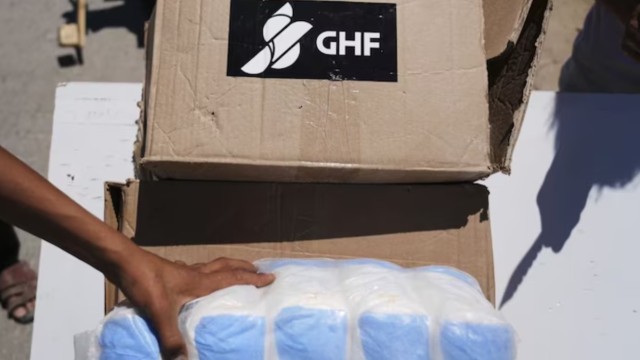
Boxes and bags of humanitarian aid delivered by the Gaza Humanitarian Foundation, a US-backed organization approved by Israel, are seen in Khan Younis, southern Gaza Strip, on May 29, 2025.
A tragic crowd surge at a Gaza food distribution site claimed 20 Palestinian lives on Wednesday. The aid center, run by the Israeli-backed American group Gaza Humanitarian Foundation (GHF), became the scene of panic and violence. Most of the victims were trampled in a stampede, and one person was fatally stabbed. This marks the first deadly incident at a GHF site, although hundreds have died in past months while trying to reach such aid locations.
Panic Erupts at Aid Site in Southern Gaza
The deadly incident unfolded between the southern cities of Khan Younis and Rafah. Witnesses say thousands had gathered early, desperate for food. The crowd surged forward at the narrow, fenced entrance of the center. According to survivors, American contractors guarding the site used loudspeakers to urge people to step back, but the density of the crowd made it impossible.
Witnesses claim GHF guards used stun grenades and pepper spray before the gates opened, triggering chaos. GHF denies using tear gas but confirmed using other crowd control measures. One survivor, Ahmed Abu Amra, described people stacked on top of each other, trying in vain to pull others from beneath the crush.
Armed Individuals Among the Crowd, GHF Claims
GHF stated that for the first time since starting operations in May, armed individuals were present in the crowd.
Spokesperson Chapin Fay said a U.S. medic was stabbed while trying to disarm a man with a pistol. GHF accused Hamas of instigating violence to disrupt the distribution, citing a photo of a confiscated weapon. However, no further evidence was presented.
The Israeli military reportedly warned GHF of possible Hamas infiltration that morning. In recent months, lawlessness has increased in Gaza, with criminal gangs and tribal factions reportedly stealing and reselling aid.
Gaza’s Humanitarian Crisis Deepens
The tragedy highlights the worsening humanitarian situation in Gaza. Over two million residents are on the brink of famine.
Distribution events have frequently turned chaotic. Videos reviewed by The Associated Press show contractors using stun grenades, tear gas, and even firing shots to control crowds at previous distributions.
The United Nations human rights office reported that 875 Palestinians have died seeking food since May. Of those, 674 were killed on their way to GHF centers. The rest were reportedly killed while waiting for aid convoys.
Israeli Airstrikes Continue, Dozens More Killed
While aid chaos claimed 20 lives on Wednesday, Israeli airstrikes added to the toll. At least 54 Palestinians were killed in separate strikes, including 14 children. Gaza City saw 22 deaths, with 11 children and three women among the casualties. Khan Younis lost 19 people, and central Gaza reported 13 more fatalities.
The Israeli military said it struck over 120 Hamas-linked targets in 24 hours, including tunnels and weapons depots. Hospitals across Gaza received 94 bodies and over 250 wounded in a single day.
A New Corridor Opens Amid War Stalemate
Israel has opened a fourth military corridor, bisecting Khan Younis in a strategic move. This expansion of control is seen as a pressure tactic on Hamas during stalled ceasefire talks in Qatar.
These narrow buffer zones have complicated previous negotiations. Israel insists on maintaining control over such corridors, citing security needs.
The Ongoing Conflict and Civilian Toll
The Israel-Hamas war has now lasted 21 months. It began with Hamas’ deadly cross-border attack on October 7, 2023, which killed around 1,200 Israelis and saw 251 hostages taken. Most hostages have since been released, but 50 remain in captivity, with fewer than half believed to be alive.
In retaliation, Israel’s military offensive has claimed over 58,000 Palestinian lives, according to Gaza’s Health Ministry. More than half of the dead are reportedly women and children. While the ministry is part of Hamas’ government, its death toll figures are widely accepted by international organizations.
As the war drags on, the hope for peace dims and the humanitarian cost continues to soar.