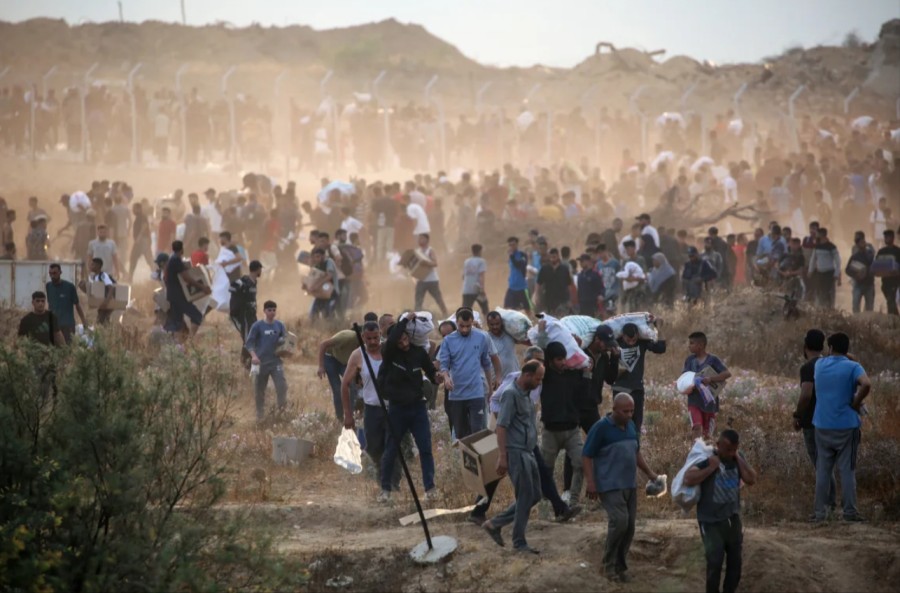
People carry relief supplies from the Gaza Humanitarian Foundation (GHF) in central Gaza on Sunday.
The humanitarian crisis in Gaza continues to spiral out of control. Despite partial easing of Israel’s blockade and a new U.S.-backed aid initiative, aid to Gaza remains scarce, unpredictable, and unsafe. Civilians are starving, hospitals are on the brink of collapse, and aid convoys are facing looting and gunfire. The situation has reached a critical point.
Starvation Forces Desperate Measures
Starvation is rampant across Gaza. The UN Office for the Coordination of Humanitarian Affairs (OCHA) warns that people are risking their lives for food. At an aid site, a woman named Umm Zuhair told CNN, “We’re so hungry that we’re willing to risk getting shot just for a kilo of flour.”
Child malnutrition is also increasing. A recent UNRWA study revealed that acute malnutrition among children under five rose from 4.7% to 5.8% in just two weeks.
Limited Aid, Even Less Reaches the Needy
Aid to Gaza has been severely limited. According to COGAT, just 350 trucks entered Gaza through Kerem Shalom last week. That’s less than 20% of the pre-war levels. Even those limited supplies often don’t reach the people most in need.
OCHA reported that out of 16 truckloads prepared for delivery last Thursday, five were rejected and six failed to arrive. Fuel and water were among the rejected items, worsening the living conditions further.
Looting and Gunfire Halt Distribution
As desperation grows, aid convoys are increasingly targeted. OCHA says looting incidents have surged, often carried out by starving civilians. The Private Transport Association in Gaza halted operations for three days after trucks were attacked. Gunfire damaged multiple trucks, and at least one driver was killed.
Despite these risks, some deliveries succeeded. On Sunday, 11 commercial trucks reached merchants in Deir al-Balah.
Gaza Humanitarian Foundation Struggles with Chaos
The U.S. and Israeli-backed Gaza Humanitarian Foundation (GHF) has faced repeated disruptions. On June 1, Israeli forces allegedly opened fire on a crowd near a GHF aid hub, killing at least 31 people. The IDF claims they fired only warning shots at "suspects."
GHF said it distributed over 17,000 food boxes on Sunday, but many people left distribution points empty-handed. Mohammad Salim, holding an empty box, said, “There’s nothing inside, not even lentils.” The absence of a structured, ID-based system has led to hoarding and mismanagement.
Hamas Threats and Militarized Aid Zones
GHF reported it could not operate on Saturday due to threats from Hamas against workers and drivers. One driver said Hamas warned drivers against continuing transfers to GHF sites. As a result, planned employee deployments were canceled.
Adding to the confusion, GHF’s announcements are inconsistent. While its Facebook page said three sites would open Monday, only two were operational. The group admitted to communication lapses.
The UN has criticized GHF’s approach, saying militarized aid delivery is unsuitable and insufficient. GHF has no operational presence in northern Gaza, where the need is most acute.
Cash, Food, and Fuel: All Critically Short
According to OCHA, 90% of families in Gaza can’t afford the few food items left in markets. Meat, vegetables, and dairy have vanished from daily diets. Community kitchens are shutting down, unable to source ingredients or due to forced displacements.
Fuel shortages are now threatening Gaza’s entire medical system. Dr. Mohamed Abu Salmiya, director of Al-Shifa Hospital, warned that without immediate fuel, all hospital operations will stop within two days. Medical staff already face impossible choices on whom to treat.
On Sunday, the Palestinian health ministry said both Al-Shifa and the Baptist Ahli Hospital may shut down within 24 hours. The south’s Nasser Medical Complex has fuel for just two more days.
Children on the Frontlines of Hunger
With families unable to provide food, children are turning to the streets. UNRWA reports more children are seen looting, working, or gathering around dangerous aid points in hopes of finding something to eat.
Without immediate and widespread access to aid, Gaza’s crisis will only deepen. The UN calls for the urgent, unhindered opening of all crossings and safe distribution routes.
The flow of aid to Gaza is not just disrupted — it's under siege. Hunger, looting, and violence are obstructing humanitarian efforts. Unless immediate changes occur, including secure and open distribution routes, Gaza faces an even darker chapter of human suffering.