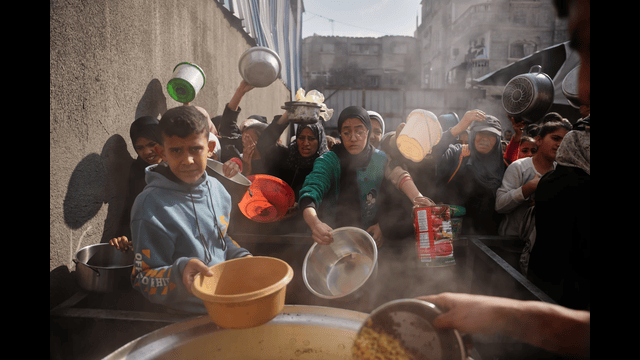
Palestinian women struggle to receive donated food at a community kitchen in Nuseirat, central Gaza Strip, Wednesday, Dec. 17, 2025.
Israeli forces fired a mortar shell into a residential area of the Gaza Strip, injuring at least 10 people. The incident has further strained the fragile Israel-Hamas ceasefire, which has faced repeated violations since taking effect in October.
Mortar Strike Sparks Fresh Tensions
The Israeli military confirmed the mortar was fired during an operation near the so-called Yellow Line. This line was created under the ceasefire agreement to separate Israeli-controlled areas from the rest of Gaza.
According to the army, the shell missed its intended target and landed inside a civilian neighborhood. The military did not disclose the original target or clarify whether troops crossed the ceasefire boundary. An investigation has been launched.
Civilians Injured in Central Gaza
Health officials in Gaza reported that the mortar strike hit central Gaza City. Al-Ahli Hospital received at least 10 wounded people, some in critical condition.
Hospital director Fadel Naeem said the injured included civilians caught by surprise during routine daily activities. The strike caused panic among residents already living under constant fear.
Repeated Violations Since Truce
This was not the first incident of Israeli fire causing casualties beyond the Yellow Line. Palestinian health authorities say more than 370 people have been killed by Israeli fire since the ceasefire began on October 10.
Israel maintains that its troops fire only in response to Hamas violations. Officials also claim most casualties were militants. However, an Israeli military official acknowledged civilian deaths in several incidents, including children and families traveling in vehicles.
Confusion Over the Yellow Line
Palestinian residents argue that civilians are being harmed because the Yellow Line is poorly marked. In many areas, visual markers have not yet been installed.
Israeli forces have begun placing yellow concrete blocks to define the boundary. Still, gaps remain, increasing the risk of accidental crossings and deadly misunderstandings.
Ceasefire Faces Uncertain Future
The Israel-Hamas ceasefire is struggling to advance into its next phase. Both sides accuse each other of failing to meet agreed terms.
The first phase involved exchanging Israeli hostages for Palestinian prisoners. The planned second phase includes deploying an international stabilization force, forming a technocratic Gaza administration, disarming Hamas, and withdrawing more Israeli troops.
Progress has stalled over unresolved disputes, including the remains of Israeli hostage Ran Gvili, which Israel demands be returned before negotiations continue.
Aid Access Remains a Major Dispute
Hamas is calling for international pressure on Israel to open border crossings and allow more humanitarian aid. Recently released Israeli data suggests aid deliveries have fallen short of the agreed 600 trucks per day, though Israel disputes those findings.
Humanitarian groups warn that aid shortages are deepening suffering across Gaza. Food remains scarce as the territory struggles to recover from famine conditions seen during the war.
Life After Devastation
Nearly all of Gaza’s 2 million residents have been displaced. Most now live in crowded tent camps or damaged buildings with limited access to basic services.
The war began after the Hamas-led October 7, 2023, attack on southern Israel, which killed about 1,200 people and took 251 hostages. Most hostages or their remains have since been returned.
The Human Cost of the Conflict
Israel’s prolonged military campaign in Gaza has killed over 70,660 Palestinians, according to Gaza’s Health Ministry. The toll includes large numbers of women and children.
While the ministry does not separate civilians from fighters, its records are widely considered reliable by international observers.
As ceasefire violations continue, hopes for stability remain fragile. Each new incident raises fears that the truce could collapse entirely.