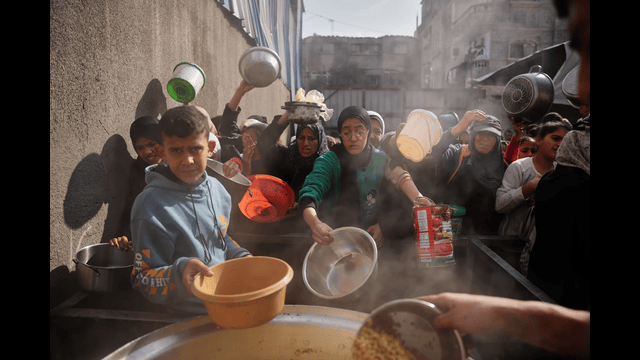
Palestinian women struggle to receive donated food at a community kitchen in Nuseirat, central Gaza Strip, Wednesday, Dec. 17, 2025
The spread of famine in the Gaza Strip has been avoided for now. However, experts warn that starvation still threatens the entire Palestinian territory. A new report says conditions remain extremely fragile despite recent improvements.
Food Crisis Shows Fragile Improvement
The latest assessment came from the Integrated Food Security Phase Classification (IPC), the world’s leading authority on food crises. The group confirmed that famine is no longer spreading across Gaza.
This marks a shift from earlier warnings. Months ago, the IPC said famine was underway in Gaza City and likely to expand. That outcome was avoided after an October ceasefire and improved humanitarian access.
Starvation Risk Still High
Despite progress, the IPC stressed that all of Gaza remains at risk of starvation. Nearly 2,000 people face catastrophic hunger levels through April.
The report warned that renewed fighting or blocked aid could push Gaza back toward famine. Sustained and unhindered humanitarian assistance remains essential.
Ceasefire Helped Ease Worst Conditions
The IPC credited reduced fighting and better access for aid deliveries for the improvement. Commercial food shipments also increased alongside humanitarian convoys.
Food availability has risen across Gaza. Many families now manage two meals per day, up from one meal during summer.
“This is clearly a reversal of the dire situation we faced earlier,” said Antoine Renard of the World Food Program.
Shelter Crisis Worsens Hunger
While food access improved, shelter conditions remain alarming. More than 70% of Gaza’s population is displaced and living in temporary shelters.
Aid groups estimate 1.3 million Palestinians urgently need emergency shelter. Many families live in flooded tents during winter rains.
Poor sanitation and hygiene worsen food insecurity. These conditions raise the risk of disease and malnutrition.
Children Face Severe Malnutrition
The IPC warned of a growing child nutrition crisis. Over the next year, more than 100,000 children under five could suffer acute malnutrition.
These children will require urgent medical and nutritional treatment to survive. Health services in Gaza remain overstretched and under-resourced.
Aid Access Still Uneven
Humanitarian access has improved compared to earlier months. However, it remains uneven and unpredictable across Gaza.
Aid flows vary daily due to security and logistical restrictions. Some areas receive consistent help, while others remain underserved.
The IPC stressed that access must remain stable to prevent further loss of life.
Israel Rejects IPC Findings
Israel’s military aid coordination agency, COGAT, rejected the IPC report. Officials said aid deliveries exceed Gaza’s nutritional needs.
Israel’s Foreign Ministry echoed that view. It claimed the IPC relies too heavily on U.N. truck data, which represents only part of total aid.
The IPC responded that its analysis includes U.N. and commercial aid, using data from both COGAT and U.N. sources.
Aid Numbers Disputed
Ceasefire terms require 600 aid trucks daily. Israeli military data suggests this target has not been met. Israel disputes those figures.
U.S. officials involved in coordinating aid say deliveries meet agreed levels. The debate continues amid growing humanitarian needs.
Aid Still Falls Short
The United Nations says it prepares 1.5 million hot meals daily in Gaza. Food packages also reach families across the strip.
Still, U.N. Secretary-General António Guterres warned needs are rising faster than aid access.
Aid groups say two years of war left deep scars. Many Palestinians cannot safely or consistently access food, water, or healthcare.
Markets Exist, Money Does Not
Some food is now available in local markets. However, prices remain unaffordable for most families.
“There is food and meat, but no one has money,” said Hany al-Shamali, displaced from Gaza City.
“How can we live?” he asked.
Recovery Remains Out of Reach
Humanitarian groups say true recovery requires more than food deliveries. Palestinians must rebuild homes, restore livelihoods, and grow food again.
For now, experts warn, the Gaza starvation crisis remains unresolved. The famine spread may be halted, but hunger still defines daily life.