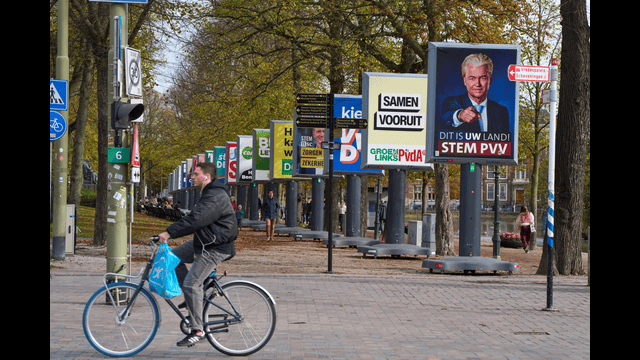
Election billboards of 26 of the 27 political parties participating in the Oct 29, general elections are lined up in the Hague, Netherlands, Wednesday, Oct 22, 2025.
Less than two years after his surprise victory, Dutch far-right leader Geert Wilders has forced another election in the Netherlands. The outspoken anti-immigration politician dissolved his ruling coalition in June, sparking a snap vote that has once again divided the country and reshaped the national debate around migration.
Wilders Triggers Political Turmoil
Geert Wilders, known for his fierce anti-Islam and anti-immigration rhetoric, withdrew his Party for Freedom (PVV) from the four-party coalition, accusing his partners of blocking his immigration crackdown. The move ended one of the shortest-lived governments in Dutch history, led by Prime Minister Dick Schoof — a civil servant chosen by Wilders himself.
Despite constant threats that have kept him under protection for two decades, Wilders remains unapologetic. He insists he had “no choice” but to bring down a coalition unwilling to support his policies.
Immigration Dominates Election Campaign
Immigration is once again the defining issue of Dutch politics. Every major party has been pushed toward stricter migration policies as Wilders’ rhetoric continues to shape public opinion. His campaign centers on a 10-point plan to completely halt asylum-seeker entries and tighten border controls with Belgium and Germany.
“The Netherlands has become one big asylum center,” Wilders said during a televised debate, defending his controversial stance as opponents accused him of political chaos and poor governance.
Coalition Challenges Loom Ahead
Even if Wilders’ party emerges as the largest in parliament, forming a majority coalition remains unlikely. Several mainstream parties have already ruled out joining him. Henri Bontenbal, leader of the center-right Christian Democrats (CDA), said Wilders and the far-right Forum for Democracy “do not defend democracy,” emphasizing the need to restore stability in Dutch politics.
University of Amsterdam professor Claes de Vreese predicts that if Wilders fails to form a majority, a minority cabinet might be considered — though such arrangements are rare in the Netherlands. “If that fails, the mandate could pass to the second-largest party,” he added.
A Global Shift Toward the Right
Experts view the Dutch political shift as part of a wider global trend. “We are seeing a steady and global rise of the far right,” said Léonie de Jonge, a researcher on far-right extremism at the University of Tübingen. She warned that the Netherlands is not immune to this political realignment.
This rise has also sparked unrest. Anti-immigration protests have turned violent in several cities, including The Hague, where rioters set a police car on fire and attacked a centrist party’s headquarters.
The Return of the Christian Democrats
After a disappointing result in 2023, the Christian Democrats have made a strong comeback under Bontenbal. Promising to “restore decency” to politics, he aims to replace what he calls “two years of division and chaos” with “hope and responsibility.” His campaign resonates with voters exhausted by political instability.
Voter Herman de Jong, interviewed in Rotterdam, echoed that sentiment. “We need stability, calmness, unity,” he said. “The constant arguing isn’t good for the people.”
Timmermans Leads Center-Left Revival
On the other side, former European Commission Vice President Frans Timmermans leads the Green Left–Labor Party alliance. He accuses the outgoing government of inaction and promises to “get this country working again.” His key pledge is to build 100,000 affordable homes annually, addressing one of the nation’s most pressing issues.
Timmermans hopes to shift the focus from immigration to social welfare, housing, and healthcare — concerns that many Dutch citizens say have been overshadowed.
A Nation Awaits Another Coalition Battle
As the Netherlands heads to the polls, the outcome remains uncertain. But one thing is clear: forming a stable coalition will be a long, complex process. With deep ideological divides and multiple parties competing for 150 parliamentary seats, negotiations could stretch for months.
King Willem-Alexander recently urged a “return to the Dutch culture of compromise,” a call many hope will resonate as the nation once again faces political gridlock.
For Dutch voters, weary of instability, the message is simple — they want a government that can finally deliver unity, order, and progress.