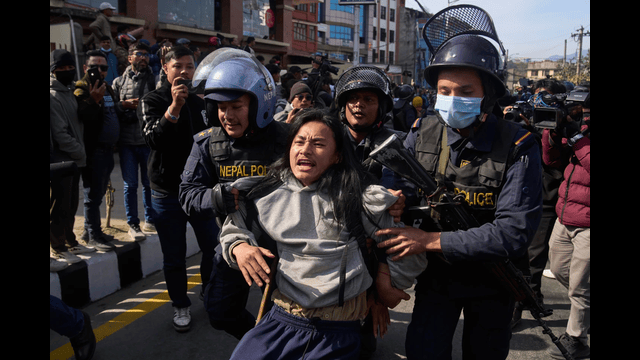
Nepalese police detain a young protester during an anti-government rally in Kathmandu, Nepal, on Dec 22, 2025.
On a clear September morning, Mukesh Awasti should have been boarding a flight to Australia.
Instead, he joined the Gen Z protests in Nepal.
That choice cost him his leg.
The 22-year-old civil engineering aspirant was shot during demonstrations in Kathmandu.
He now lies in a hospital bed at the National Trauma Center.
His left leg has been amputated.
His sense of regret runs deeper than his injury.
Awasti says the Gen Z protests in Nepal brought sacrifice, not change.
The government they helped create, he believes, has failed them.
A movement born from anger and urgency
The Gen Z protests in Nepal erupted on September 8.
Young demonstrators flooded Kathmandu’s streets.
They protested corruption, unemployment, and broken governance.
A sudden ban on social media became the final trigger.
What began as peaceful rallies soon turned violent.
Security forces opened fire after crowds breached police barricades.
Seventy-six people were killed.
More than 2,300 were injured.
Within days, protests spread nationwide.
Government buildings were torched.
Homes of senior politicians were attacked.
Several leaders fled by army helicopters.
Political collapse and a historic appointment
As pressure mounted, the army intervened to restore order.
Negotiations followed quickly.
On September 12, Nepal appointed an interim leader.
Sushila Karki became Nepal’s first female prime minister.
A retired Supreme Court judge, she promised stability.
Her key commitment was fresh parliamentary elections in March.
For many Gen Z protesters in Nepal, her appointment felt like a victory.
They believed sacrifice had finally forced accountability.
That optimism faded quickly.
Gen Z protesters feel betrayed
Weeks later, anger has returned to the streets.
Dozens of injured protesters have resumed demonstrations.
They now protest outside the prime minister’s office.
Suman Bohara is among them.
He walks with crutches after his foot was shattered in September.
He says families of victims remain ignored.
“The government has done nothing,” Bohara said.
“No justice, no compensation, no accountability.”
Police have dispersed several of these recent protests.
The scenes mirror the unrest Gen Z hoped was over.
Anti-corruption promises fall short
Ending corruption was central to the Gen Z protests in Nepal.
Yet progress has been limited.
Only one major corruption case has been filed so far.
That case excludes senior political figures.
Leaders accused by protesters face no charges.
Many are preparing to contest the upcoming elections.
Those in power during the shootings remain untouched.
No arrests have followed the use of live fire.
This silence fuels growing resentment.
Elections divide the Gen Z movement
Prime Minister Karki insists elections remain the priority.
She says preparations are nearly complete.
Security conditions, according to her, have improved.
But Gen Z protesters in Nepal are divided.
Some reject elections as insufficient.
They demand immediate arrests and systemic reform.
Others believe elections are the only path forward.
They want new lawmakers to dismantle corruption legally.
The movement lacks a unified voice.
Analysts point to leadership vacuum
Political analysts say confusion weakens the Gen Z protests in Nepal.
There is no single leader or clear roadmap.
Demands vary sharply between groups.
Abeeral Thapa of Polygon College in Kathmandu explains the dilemma.
He says unclear demands stalled momentum.
The government’s role was never fully defined.
Nepal’s constitution offers no clear framework for interim governments.
The president cited elections as the sole mandate.
Anything beyond that remains legally uncertain.
Uncertain road ahead
Some Gen Z activists now oppose the March polls.
Others warn there is no alternative to elections.
The deadlock deepens national uncertainty.
For protesters like Awasti, the cost already feels unbearable.
Lives were lost.
Bodies were broken.
The Gen Z protests in Nepal reshaped power overnight.
Whether they reshape the system remains an open question.