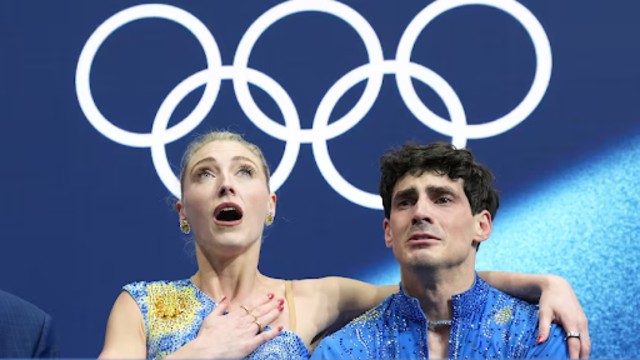
Piper Gilles and Paul Poirier of Canada react to their scores in the ice dance free skate on Wednesday, securing them a bronze medal.
For Piper Gilles and Paul Poirier, the Olympic journey never had a single beginning.
It unfolded through countless moments, small decisions, and years of shared ambition.
From childhood skates to elite competition, every step quietly shaped their destiny.
In Milan, that journey finally delivered the ending they had long chased.
Gilles and Poirier are now Olympic medallists.
A Partnership Built Over Time
The Canadian ice dance pair has skated together since 2011.
Their partnership grew through setbacks, near misses, and unwavering trust.
Each competition added pressure, while expectations steadily followed them.
Two previous Olympic appearances ended without a podium finish.
Still, they returned stronger, believing patience would one day be rewarded.
That belief carried them to the Milano Ice Skating Arena.
Ice Dance at Its Most Ruthless
Olympic ice dance leaves no room for sentiment.
Twenty teams competed in reverse ranking order after the rhythm dance.
The arena’s staging reflected the tension perfectly.
White armchairs awaited temporary leaders.
White cubes stood nearby for second and third positions.
Teams moved forward, then vanished behind a blue curtain.
With each higher score, another dream quietly ended.
The process was elegant, theatrical, and unforgiving.
Pressure After Recent Controversy
Recent months had tested Gilles and Poirier deeply.
At December’s Grand Prix Final, judging decisions sparked frustration and doubt.
They slipped off the podium behind Britain’s Lilah Fear and Lewis Gibson.
In Milan, the standings felt eerily familiar.
Canada sat third after the rhythm dance.
Britain followed closely in fourth, separated by fractions.
When Fear and Gibson skated, whispers filled the arena.
They needed perfection to overtake the Canadians.
It never came.
A Skate That Delivered Peace
Gilles and Poirier stepped onto the ice next.
They knew a medal was within reach, barring disaster.
What followed was controlled, emotional, and beautifully complete.
Their free dance flowed with precision and vulnerability.
As the music ended, they collapsed into each other’s arms.
Tears followed, not shock, but release.
Gilles later described the moment as peaceful.
She spoke of absorbing the crowd’s energy and familiar faces.
Poirier’s rare display of emotion said everything words could not.
Gilles and Poirier Olympic Bronze Confirmed
The scores confirmed what the performance suggested.
They earned a season-best free skate score of 131.56.
Their total reached 217.74 points.
That margin placed them more than eight points clear of challengers.
The Gilles and Poirier Olympic bronze was secured.
At last, they settled into the white armchairs.
American pair Madison Chock and Evan Bates held second place.
France’s Gabriella Papadakis and Guillaume Cizeron claimed gold.
Only Gilles and Poirier remained comfortably seated.
Belief Through Adversity
For Poirier, the season demanded daily resolve.
After the Grand Prix disappointment, belief did not come easily.
Confidence had to be rebuilt intentionally, day by day.
They chose faith over frustration.
They chose patience over resentment.
That mindset shaped their Olympic skate.
Poirier later reflected that belief made the difference.
It allowed them to deliver when it mattered most.
The Olympics finally met them at their peak.
An Ending That Feels Like a Beginning
Their journey to Milan began at Toronto’s Pearson Airport.
Passengers applauded as they boarded their overnight flight.
Even then, the weight of possibility followed them quietly.
Somewhere over the Atlantic, a stranger asked Gilles why she was traveling.
“I’m a figure skater,” she replied.
One day, she will not say that anymore.
Both skaters are 34 now.
They may continue competing briefly, but this level may never return.
This chapter is closing.
Yet the medal reshapes everything.
Gilles and Poirier Olympic bronze is not just a finish.
It is the beginning of their legacy as Olympic medallists.