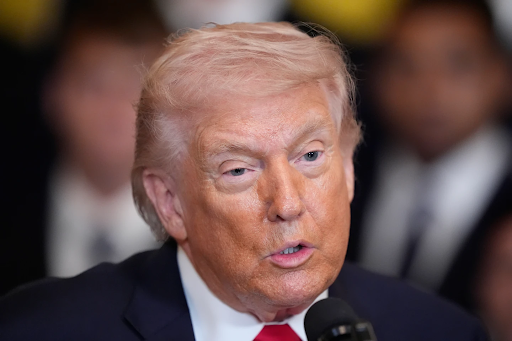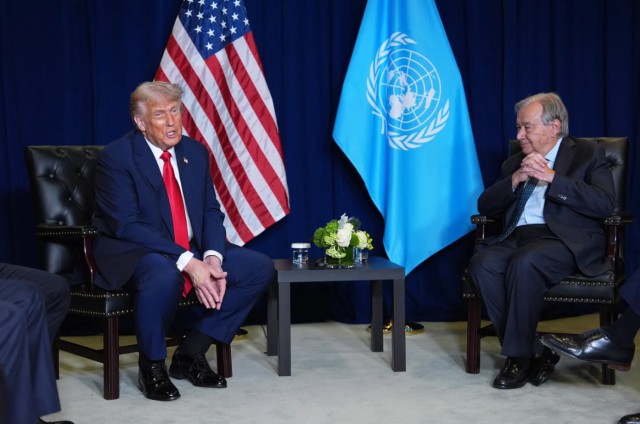
President Donald Trump meets with United Nations Secretary-Anteno Guterres during the United Nations General Assembly, Thursday, Sept 23, 2025.
The United Nations is preparing for a large-scale reduction in its peacekeeping operations following a major cut in U.S. financial support. Thousands of soldiers and police officers will be withdrawn from conflict zones across the world in the coming months as part of this downsizing plan.
Massive Reduction in Peacekeeping Forces
According to a senior UN official, peacekeeping missions will face a 25% reduction in personnel worldwide. The move comes as the United States—the UN’s largest financial contributor—implements new funding policies in line with President Donald Trump’s “America First” agenda.
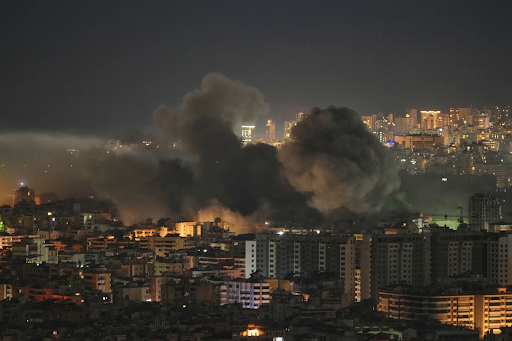
This reduction means 13,000 to 14,000 troops and police officers out of over 50,000 deployed peacekeepers will return home. The cut will also affect UN operations in Somalia and other regions. The overall peacekeeping budget will shrink by 15% this year, significantly impacting missions in Congo, South Sudan, Lebanon, Cyprus, Kosovo, and the Central African Republic.
Global Impact of US Funding Cuts
Each of the UN’s 193 member nations contributes financially to peacekeeping missions. However, the U.S. has historically covered nearly a quarter of the total cost. The recent decision to scale back U.S. funding will therefore have global consequences.
In a private meeting, Secretary-General Antonio Guterres emphasized that UN peacekeeping remains “one of the most effective and cost-efficient tools” for maintaining global peace. He noted that its budget represents only “half of one percent of global military spending.” Despite this, the U.S. is pressing for reforms, citing inefficiency and redundancy across UN programs.
Trump Administration Pushes for UN Reforms
The U.S. government has long argued that the UN’s bureaucracy is bloated. Ambassador Mike Waltz, representing the U.S. at the UN, stated that America will withhold additional funding until a full review of UN agencies is completed.
President Trump’s administration has already withdrawn from UNESCO, the World Health Organization, and the UN Human Rights Council, citing financial strain and lack of accountability. A similar review has prompted 20% job cuts across more than 60 UN offices and agencies, marking a deep shift in how the U.S. engages with international organizations.
In a recent interview, Waltz reaffirmed the administration’s stance: “We want the UN to get back to its basics—promoting peace, enforcing peace, preventing wars. We have to cut out all of this other nonsense.”
A Shrinking Global Presence
UN peacekeeping efforts have expanded significantly since the end of the Cold War. In the early 1990s, the organization deployed around 11,000 peacekeepers. By 2014, that number had risen to 130,000 across 16 missions. Today, about 52,000 personnel serve in 11 conflict zones spanning Africa, Asia, Europe, and the Middle East.
With the new funding cuts, the U.S. will contribute $680 million to nine peacekeeping missions—down from $1 billion last year. The remaining funds will prioritize key operations in Lebanon and the Democratic Republic of Congo, where American strategic interests are highest.
China’s Role and the Future of UN Peacekeeping
Together, the U.S. and China account for nearly half of the UN’s peacekeeping budget. While the U.S. has reduced its contribution, China has pledged to pay its full share by year-end, according to senior UN sources.
The reductions mark one of the most significant overhauls in UN peacekeeping history. As funding tightens, missions across the globe may struggle to maintain stability in conflict regions.
Analysts warn that the drawdown could leave vulnerable areas exposed and undermine years of progress in peacebuilding efforts. For now, the UN faces a tough balancing act—maintaining its global commitment to peace while adjusting to the realities of reduced U.S. support.