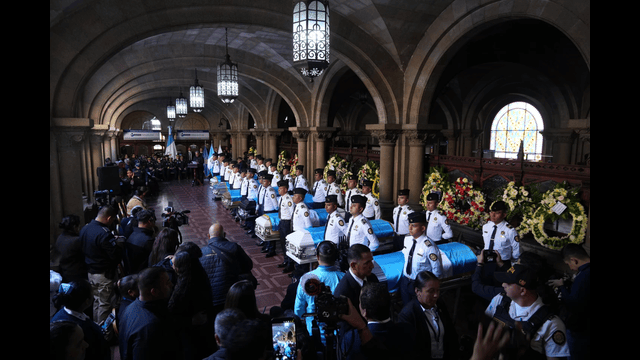
The wake for police officers killed while retaking control of three prisons is held at the Interior Ministry in Guatemala City, Monday, Jan. 19, 2026.
Guatemala is facing one of its most severe security crises in recent years.
The death toll from coordinated gang attacks on police has risen to nine.
The violence has pushed the government to declare a nationwide state of emergency.
Authorities confirmed Monday that another police officer died from critical injuries.
Several others remain hospitalized with life-threatening wounds.
Some officers suffered amputations during the attacks.
Prison Riots Spark Nationwide Violence
The unrest began on Saturday with coordinated prison riots.
Inmates seized control of three major prisons across the country.
At least 43 prison guards were taken hostage.
Officials said gangs were demanding privileges for their leaders and members.
Security forces regained control of one prison early Sunday.
Shortly after, attacks on police erupted across Guatemala City.
Investigators believe the assaults were carefully planned.
Authorities say criminal gangs targeted officers in retaliation.
Police Losses Confirmed
National Civil Police Director David Custodio Boteo confirmed the ninth death Monday.
He said several wounded officers remain in critical condition.
The scale of injuries shocked the nation.
A formal ceremony honored the fallen officers at the Interior Ministry.
Flag-draped coffins lined the hall during the tribute.
Families and officials gathered in silence.
President Bernardo Arévalo addressed the families during the ceremony.
He promised the nation would not forget the sacrifice.
He described the officers as heroes who died fulfilling their duty.
Families Demand Justice
Outside the ministry, grief was visible among relatives.
José Antonio Revolorio mourned his 25-year-old son, a slain officer.
He demanded justice and accountability.
He said his son was honest and dedicated.
He urged authorities to ensure the crimes do not go unpunished.
Many families echoed similar calls.
Guatemala State of Emergency Takes Effect
On Monday, the government gazette published the emergency decree.
The Guatemala state of emergency will last 30 days.
It cites coordinated gang actions against security forces.
The declaration limits freedom of movement and public demonstrations.
Police may arrest suspected gang members without court orders.
Security forces can restrict vehicle movement and conduct searches.
Congress approved the Guatemala state of emergency Monday night.
Lawmakers voted 149 in favor and one against.
Ten members were absent or on leave.
The measures had already taken effect on Sunday.
Daily Life Disrupted in Capital
Security presence increased across Guatemala City.
Traffic appeared lighter than usual on Monday.
Many residents stayed indoors.
Óscar López, a radio technician, said people felt psychological fear.
He supported the emergency declaration for restoring calm.
Others shared similar concerns.
Ileana Melgar delayed errands due to safety fears.
She worried public transport might be suspended.
She asked a friend to accompany her.
International Response and Warnings
The U.S. Embassy initially ordered staff to shelter in place.
That instruction was lifted later Sunday.
Officials advised heightened caution while traveling.
On Monday, the embassy strongly condemned the attacks.
It described the perpetrators as terrorists.
The statement reaffirmed support for Guatemala’s security forces.
Tougher Laws Against Gangs
Last October, Congress labeled major gangs as terrorist organizations.
These include Barrio 18 and Mara Salvatrucha.
Penalties for gang crimes were significantly increased.
The United States also designated the gangs as foreign terrorist groups last year.
Officials say these measures aim to weaken criminal networks.
Schools Closed as Precaution
As violence continues, authorities suspended classes nationwide on Monday.
Officials called it a safety measure for students.
The Guatemala state of emergency remains under close watch.