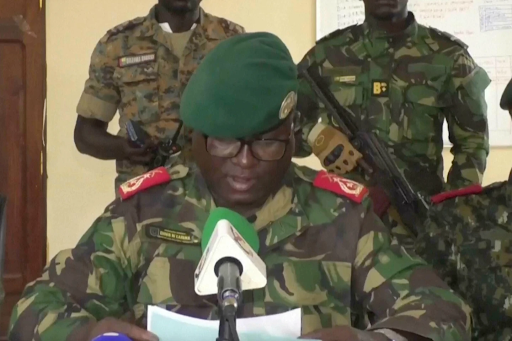
Dinis N’Tchama, military spokesperson, speaks on Wednesday, Nov. 26, 2025 in Bissau, Guinea-Bissau.
Soldiers in Guinea-Bissau appeared on state television on Wednesday and declared they had seized power. Their announcement came after reports of heavy gunfire near the presidential palace, only three days after the country held national elections.
President Umaro Sissoco Embaló later told French media that he had been deposed and arrested by the military.
Military Says It Has Removed President
The army issued its declaration through spokesperson Dinis N’Tchama. He said the High Military Command decided to remove the president and suspend all state institutions in the Guinea-Bissau coup.
He claimed the action was taken after the alleged discovery of a “plan to destabilize the country.” According to him, the plot involved national politicians, foreign actors, and a “well-known drug lord.” No names or evidence were provided.
The military also announced the suspension of the electoral process, closure of all borders, and shutdown of the country’s media outlets.
Guinea-Bissau has experienced four coups and many attempted ones since independence. It has also become a key transit hub for drug trafficking between Latin America and Europe.
Election Crisis Sparks Tension
The coup unfolded shortly after Sunday’s presidential and legislative elections. Both incumbent President Embaló and opposition candidate Fernando Dias claimed victory, even though official provisional results were expected only on Thursday.
This political disagreement deepened an already tense atmosphere in the country.
How the Coup Unfolded
Gunfire erupted near the presidential palace around midday on Wednesday. Roads leading to the compound were blocked, and soldiers in masks and heavy weapons manned checkpoints.
Sources inside the palace said a group of armed men attempted to attack the building. Guards responded, leading to an exchange of shots. Another Interior Ministry official reported gunfire around the National Electoral Commission headquarters.
Election observers later confirmed that the commission chief had been arrested and the office sealed off by soldiers.
President Embaló communicated through intermediaries that he was being held by the military. In interviews with Jeune Afrique and France 24, he said he had been arrested but not harmed.
“I have been deposed,” he said, describing the action as a coup led by the army chief of staff.
Political Legitimacy Dispute
The president was already facing a significant legitimacy crisis. Opposition leaders argued that Embaló’s term had expired in February 2024. The Supreme Court, however, ruled that his term should end on September 4.
The presidential election, originally scheduled earlier in the year, was delayed to November, creating further tension.
During the Guinea-Bissau coup, soldiers also detained Embaló’s rival Fernando Dias and former Prime Minister Domingos Simões Pereira. Pereira, widely considered a major challenger, had been barred from the election but had endorsed Dias.
Calls for a Return to Constitutional Rule
International organizations reacted swiftly.
A U.N. spokesperson said the global body was watching the crisis “with deep concern.” U.N. Secretary-General António Guterres urged all parties to uphold the rule of law.
Election observer missions from the African Union and ECOWAS condemned the takeover as an attempt to derail democracy. They demanded the immediate release of detained electoral officials and a prompt return to constitutional order.
Accusations of a “Simulated Coup”
A civil society coalition called the Popular Front accused Embaló and the military of staging a fake coup. The group claimed the event was orchestrated to block Thursday’s release of election results.
They alleged that Embaló planned to install an interim government and then run again in fresh elections.
A Region Familiar With Coups
The Guinea-Bissau coup adds to a troubling trend in West and Central Africa. Since 2020, Mali, Niger, Burkina Faso, Guinea, and Gabon have all experienced military takeovers.
Most juntas justified their actions by citing insecurity, corruption, or failed governance. Critics argue they have weakened democratic institutions across the region.