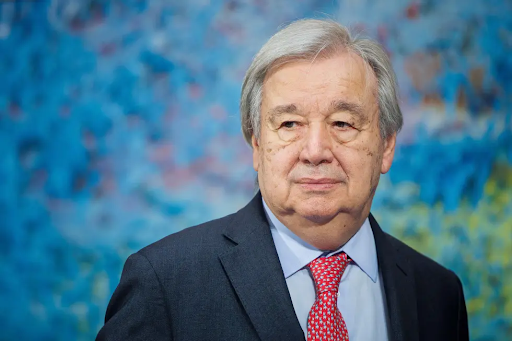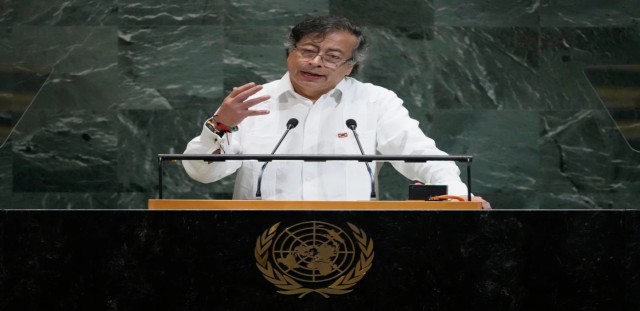
President of Columbia Gustavo petro Urrego addresses the 80th session of the United Nations General Assembly, Tuesday, Sept 23, 2025.
Colombian President Gustavo Petro has called for a criminal investigation into U.S. President Donald Trump and senior officials following deadly military strikes in the Caribbean earlier this month.
Speaking at the United Nations General Assembly on Tuesday, Petro condemned the three U.S. attacks on boats that Washington claimed were transporting drugs. He accused Trump of criminalizing poverty and migration while justifying military actions that cost innocent lives.
“Criminal proceedings must be opened against those officials, even if it includes the highest-ranking order giver: President Trump,” Petro declared.
Petro Challenges U.S. Justification
The Trump administration said the strikes targeted boats linked to Venezuela’s Tren de Aragua gang. But Petro dismissed the claim, stressing that the victims were not criminals.
“If the boats carried drugs, their passengers were not traffickers,” Petro argued. “They were poor young Latin Americans with no alternatives.”
His statement highlighted a sharp divide over how Washington interprets anti-drug operations in the region.
Details of the Deadly Strikes
The first attack occurred on September 2 and left 11 people dead, according to U.S. officials. The military claimed the vessel had changed course and was heading back to shore before being fired upon multiple times.
A second strike on September 16 targeted another boat from Venezuela, killing three more people.
Days later, on September 20, a third strike in the Caribbean killed three additional passengers.
In total, 17 people died across the three operations. The U.S. has defended the actions as necessary to curb the flow of drugs into its territory. However, it has not revealed how it determined the cargo content or the alleged gang affiliations.
Petro’s Rebuke at the UN
Addressing world leaders, Petro directly challenged Washington’s narrative. He questioned whether it was ever necessary to launch missiles against unarmed civilians.
“They claimed the missiles in the Caribbean were to stop drug trafficking. That is a lie,” Petro said. “Was it really necessary to bomb poor, unarmed young people?”
His sharp words came just hours after Trump himself addressed the assembly, intensifying the diplomatic clash.
Venezuela’s Response
Petro’s remarks followed an announcement by Venezuelan President Nicolás Maduro. Maduro revealed that his government is drafting constitutional decrees to defend national sovereignty against possible U.S. military aggression.
Maduro also accused the Trump administration of using drug trafficking allegations as a pretext to weaken and potentially overthrow his government.
The two leaders’ united front underscores growing resistance in Latin America to Washington’s military strategy in the region.
Strained U.S.-Latin America Relations
The strikes mark a new chapter in Washington’s decades-long war on drugs. But critics argue that the operations reflect more about U.S. power projection than genuine anti-trafficking measures.
Petro, Colombia’s first leftist president, restored diplomatic ties with Venezuela in 2022 after years of strained relations. His call for a criminal probe against Trump now signals Colombia’s willingness to openly challenge U.S. policy.
The controversy also deepens questions around international law, sovereignty, and the limits of military intervention in Latin America.
A Call for Accountability
By urging criminal investigations, Petro has forced the issue into the global spotlight. His demand challenges not only the legality of U.S. actions but also the broader framework of how drug wars are waged.
For now, the United States continues to stand by its military response, while Latin American leaders push back against what they view as unjustified force.
The Caribbean strikes have become more than a military incident. They now represent a test of accountability, power, and justice in international politics.