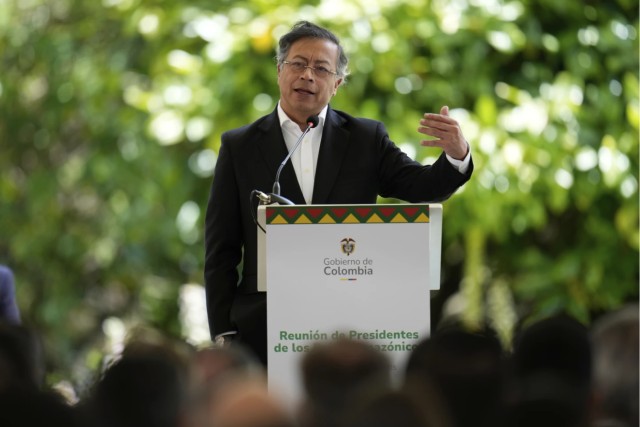
Colombia’s President Gustavo Petro speaks during a meeting of leaders of the Amazon Cooperation Treaty Organization in Bogota,Colombia, Aug 22, 2025.
Colombia’s President Gustavo Petro has launched a fierce attack on the Trump administration after Washington added Colombia to its list of nations failing to cooperate in the global drug war. The move marks the first time in three decades that Colombia has received such a designation, sparking tensions between the two allies.
On Tuesday, Petro used his X account to accuse the United States of meddling in Colombian politics. He claimed the Trump administration is attempting to push for a “puppet president” ahead of Colombia’s upcoming 2026 elections.
“The Colombian people will decide if they want a puppet or a sovereign nation,” Petro wrote. He added that he would not let Colombia “kneel” before Washington’s interests or allow farmers growing coca to be “beaten up” for survival.
U.S. Rebuke Over Cocaine Surge
The Trump administration announced the decertification on Monday. It declared that Colombia had failed to honor its international commitments to combat drug trafficking. Officials pointed to a lack of progress in curbing the cocaine trade, despite Colombia being a long-standing ally in Washington’s anti-drug efforts.
The move is considered a stunning diplomatic rebuke. It comes at a time when cocaine production is soaring in Colombia. According to the United Nations Office on Drugs and Crime, coca cultivation reached a record 253,000 hectares in 2023, nearly triple the amount from a decade ago.
Even with the decertification, Washington issued a waiver to prevent aid cuts that could impact security cooperation and humanitarian programs.
U.S. Embassy Attempts Reassurance
John McNamara, the U.S. embassy’s charge d’affaires in Bogotá, said cooperation with Colombia would continue despite the setback.
“We will do everything possible to fight alongside the Colombian people against the global drug threat,” McNamara told Blu Radio. He stressed that consular services, humanitarian projects, and defense initiatives would remain unaffected.
Still, the announcement highlights the growing rift between the Trump administration and Colombia’s first leftist president.
Petro’s Confrontational Stance
Gustavo Petro, a former rebel, has repeatedly clashed with Washington on key issues. He has denied several U.S. extradition requests and openly criticized American policies on immigration and drug enforcement, particularly in neighboring Venezuela.
Petro has also made controversial remarks, claiming that whisky kills more people than cocaine. He argues that U.S. opposition to cocaine is rooted in its production in Latin America, rather than genuine health concerns.
Such statements have angered U.S. officials, who accuse Petro of undermining regional cooperation in the fight against drug cartels.
Expert Analysis: Political Tensions Ahead
According to Sandra Borda, an international relations professor at Los Andes University in Bogotá, the decertification is unlikely to disrupt military cooperation. Colombian security forces are expected to continue operations against drug traffickers.
However, she warned that political tensions between the two governments will likely intensify. Petro, she said, could use the U.S. decision to fuel anti-American sentiment and consolidate his support base before the elections.
“The relationship between Petro and Trump has been rocky,” Borda explained. “What we are likely to see now is an escalation in hostile rhetoric.”
Trump Administration’s Harsh Report
In its official determination to Congress, the Trump administration placed the blame squarely on Petro’s leadership. It criticized his peace talks with armed groups, calling them failed negotiations with “narco-terrorist organizations.”
The report praised Colombia’s security institutions and local authorities for their efforts. But it stressed that “the failure to meet drug control obligations over the past year rests solely with Colombia’s political leadership.”
Strong Words from Washington
U.S. Secretary of State Marco Rubio also weighed in on Tuesday. He acknowledged Colombia’s historic partnership with the United States but delivered a sharp critique of Petro.
“Colombia has been a great partner historically,” Rubio told reporters. “But they now have a president who, aside from being erratic, has not been a reliable partner in fighting drug cartels.”
Colombia-U.S. Relations at a Crossroads
The drug war decertification has cast a shadow over one of Washington’s closest alliances in Latin America. While military cooperation may continue, the political clash between Petro and the Trump administration is expected to deepen.
As Colombia approaches its presidential election, Petro seems determined to frame the U.S. rebuke as an attack on national sovereignty. Meanwhile, Washington insists the surge in cocaine production must be addressed with stronger action.
For now, Colombia’s drug war remains a flashpoint that could reshape relations between Bogotá and Washington in the years ahead.