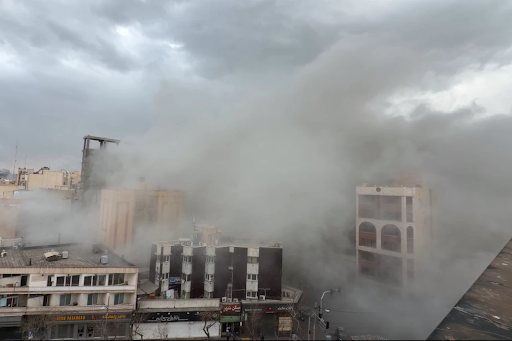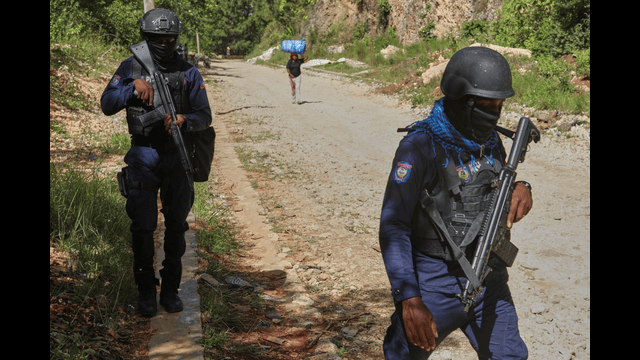
Police officers patrol the area near the Saint-Helene orphanage in the Kenscoff neighborhood of Port-au-Prince, Haiti, Monday, Aug. 4, 2025.
A new chapter in Haiti's leadership began Thursday, but dark clouds of gang violence still loom large. Business leader Laurent Saint-Cyr officially assumed the rotating presidency of Haiti’s transitional council, aiming to restore order to a country in deep crisis.
But even as hope stirred inside government offices, chaos erupted in the streets. Armed gangs, already controlling nearly 90% of Port-au-Prince, intensified their threats.
Gangs Vow to Overthrow Government
Just hours before the swearing-in, a violent warning came from Jimmy “Barbecue” Chérizier, leader of the Viv Ansanm gang.
In a chilling video posted on social media, Chérizier demanded open passage for his gunmen through the capital.
“Help us free the country,” he urged Haitians, as gunfire echoed in several areas. Streets that are usually bustling turned eerily quiet.
Security Forces Step In
A U.N.-backed mission led by Kenyan police responded swiftly. It reported thwarting gang plans with 24/7 patrols, bolstered deployments, and protection of key infrastructure.
“Gangs had aimed to make the country ungovernable,” said the mission, which faces serious limitations of its own.
Saint-Cyr’s Message: Act Now
During his first address, Saint-Cyr admitted the country is facing one of its worst-ever crises.
“It’s not time for speeches. It’s time for action,” he declared.
He urged the Haitian armed forces to ramp up operations and appealed to international allies for more troops, training, and resources.
“Our top priority is security,” he stated. “We must restore state authority and rebuild institutions.”
Public Reactions Mixed
Though some citizens are skeptical about the private sector taking charge, others voiced support.
Dozens gathered near the council’s office in solidarity, waving signs with Saint-Cyr’s photo and wearing white T-shirts.
Saint-Cyr, formerly the head of Haiti’s Chamber of Commerce, promised to work for all citizens, not just business elites.
Violence on the Rise
Despite the leadership change, violence continued.
A woman was found dead in her car after gunshots were fired near Port-au-Prince. In Kenscoff, once a quiet farming town, gangs ambushed security forces.
Two armored police vehicles were lost in gang-trapped trenches. Officers were attacked with Molotov cocktails, with three injured but still holding their ground.
Gang members later posted videos celebrating their victory and taunting authorities.
U.N. Mission Faces Major Gaps
In a separate report, the U.N. security mission revealed just how under-resourced they are.
Only 991 personnel have been deployed—less than half the 2,500 planned.
With just $112 million in funding, they’re far from the estimated $800 million needed annually.
Worse, there’s no air support and limited ground vehicles, making large-scale operations nearly impossible.
Only 200 officers can be deployed at a time.
Gangs Growing Bolder
The security vacuum has emboldened gangs. In one recent incident, eight people—including an Irish missionary and a 3-year-old child—were kidnapped from an orphanage in Kenscoff.
These groups continue to terrorize communities while leveraging fear and firepower.
Since President Jovenel Moïse's assassination in 2021, gang-related violence has displaced 1.3 million people.
From April to June alone, at least 1,520 were killed and over 600 injured, according to the United Nations Integrated Office in Haiti.
Urgency for Unified Action
Saint-Cyr didn’t mince words during his first speech. He challenged fellow leaders to rise above political division.
“The lack of vision and irresponsibility brought us here,” he said. “Now, we must be courageous.”
With Haiti standing at a crossroads, the path ahead demands not just hope—but immediate, united, and decisive action.