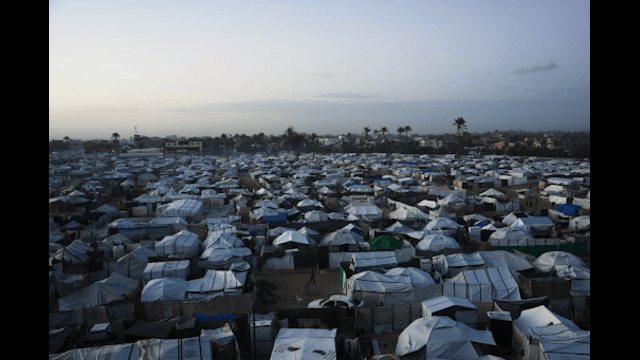
A tent camp for displaced Palestinians stretches across an area in Deir al-Balah, in the central Gaza Strip, Saturday, Jan 10, 2026.
Hamas has announced it will dissolve its Gaza government once a new Palestinian technocratic body assumes control.
The move is part of a U.S.-brokered peace plan aimed at reshaping Gaza governance after weeks of conflict.
However, no clear timeline has been shared, leaving uncertainty over when the transition will begin.
Hamas Signals Conditional Exit From Gaza Governance
The statement came on Sunday, with Hamas saying it would step aside once the technocratic committee takes over.
This committee is meant to govern Gaza without political affiliations.
Its formation is a core requirement of the peace plan.
So far, no names have been officially announced.
Hamas and the Palestinian Authority have yet to agree on the final list.
Approval from Israel and the United States also remains unclear.
These unresolved steps continue to delay the new Gaza governance structure.
Technocratic Committee Still Taking Shape
Hamas spokesperson Hazem Kassem urged faster action on forming the committee.
He shared the message through his official Telegram channel.
According to an Egyptian official, talks are progressing behind closed doors.
Hamas is expected to meet other Palestinian factions this week.
The goal is to finalize the committee’s composition.
Senior Hamas negotiator Khalil al-Hayya will lead the delegation.
The committee is expected to manage Gaza’s civil affairs.
It will operate under international oversight.
This oversight will come from a newly formed body.
Board of Peace to Oversee Gaza Transition
The peace plan introduces a new international body called the “Board of Peace.”
It is expected to supervise Gaza governance and the ceasefire process.
The board will also oversee Hamas disarmament and security arrangements.
Former U.S. President Donald Trump has promoted the board as central to the plan.
Its members have not yet been announced.
U.S. officials say progress on disarmament and reconstruction remains limited.
Israeli Prime Minister Benjamin Netanyahu named Nickolay Mladenov as the board’s director-general.
Mladenov is a former U.N. Middle East envoy.
He previously worked to reduce Israel-Hamas tensions.
Ceasefire Holds, But Violence Persists
The ceasefire began on October 10.
It included a halt in fighting and a hostage-prisoner exchange.
The deal is still in its first phase.
Despite this, violence in Gaza continues.
Israeli gunfire killed three Palestinians on Sunday, hospital officials said.
Two men were killed in Bani Suhaila.
Another man died in Gaza City’s Tuffah neighborhood.
Israel’s military said those killed were militants approaching troops.
Hamas and Israel continue to accuse each other of ceasefire violations.
Local health officials report over 400 Palestinian deaths since the ceasefire began.
International Diplomacy Intensifies
Israel’s Foreign Minister Gideon Saar met Japan’s Toshimitsu Motegi in Jerusalem.
Saar reaffirmed Israel’s commitment to the peace plan.
Motegi expressed Japan’s readiness to support the ceasefire.
Motegi visited the ceasefire monitoring center.
He was also scheduled to meet Israeli and Palestinian leaders.
Japan has signaled interest in playing a stabilizing role.
Israeli Political Scandal Adds Pressure
Separate from Gaza governance, political turmoil emerged in Israel.
Police questioned a senior official from Netanyahu’s office on Sunday.
The case involves alleged obstruction of a classified information leak probe.
Israeli media identified the official as Tzachi Braverman.
He is Netanyahu’s chief of staff and a future UK ambassador nominee.
The investigation centers on leaks to a German tabloid last year.
Opposition leader Yair Lapid demanded Braverman’s suspension.
He called the appointment inappropriate amid serious allegations.
Saar defended Braverman, saying removal requires formal charges.
Gaza Governance Remains Uncertain
The announcement to dissolve the Hamas Gaza government marks a major shift.
Yet many steps remain incomplete.
Without clarity on timelines and approvals, Gaza’s political future stays uncertain.