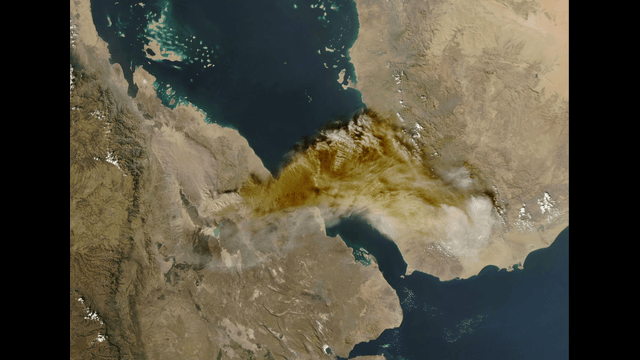
This satellite image released by NASA Worldview shows the Hayli Gubbi volcano in Ethiopia erupting on Nov. 23, 2025.
The long-dormant Hayli Gubbi volcano in northern Ethiopia has finally calmed down after days of intense activity. The rare eruption, the first in 10,000 years, left villages blanketed in ash, disrupted daily life, and triggered widespread flight cancellations across several countries.
Ash-Covered Villages Struggle After Volcano Eruption
Communities in Afdera district in Ethiopia’s Afar region bore the brunt of the eruption. Thick volcanic ash settled on villages, covering homes, grasslands, and water sources.
Health officials reported widespread coughing and respiratory issues among residents due to the ash-filled air. Mobile medical units were deployed to remote neighborhoods, including Fia and Nemma-Gubi, to support affected families.
Livestock also suffered significant hardship. Animals could not access clean water or graze because everything was coated in volcanic ash. Local officials warned that livestock survival would remain a challenge until water sources were restored.
Flight Cancellations Ripple Across Countries
The Hayli Gubbi volcano eruption produced ash plumes that climbed into high-altitude air routes, forcing airlines to suspend or reroute flights for safety.
Ash clouds drifted across the Red Sea, Yemen, Oman, the Arabian Sea, and reached western and northern India, prompting major flight disruptions.
Air India canceled 11 flights, most of them international, to allow mandatory aircraft inspections. The cancellations followed safety directives issued by India’s aviation regulator.
Other carriers, including Akasa Air, halted services to Jeddah, Kuwait, and Abu Dhabi due to hazardous flying conditions.
At New Delhi’s Indira Gandhi International Airport, at least seven international flights were canceled and more than a dozen were delayed as airlines navigated the ash threat. The ash cloud was expected to clear from Indian skies by late Tuesday.
Health and Livelihood Concerns Rise in Afar Region
Local authorities in Ethiopia have been working urgently to protect residents from the health impacts of volcanic ash.
Two emergency medical teams were dispatched to the most affected kebeles, offering treatment and monitoring respiratory cases.
Livestock experts warned of a growing crisis for pastoral communities. Ash-covered water sources and grazing land have left animals without essentials. In rural Afar, livestock loss could push families into severe economic hardship.
Experts Explain the Rare Hayli Gubbi Volcano Eruption
Scientists believe the eruption was triggered by Ethiopia’s position along an active rift system, where volcanic and seismic activity is common.
Geologist Atalay Ayele from Addis Ababa University explained that such eruptions are part of the region’s natural tectonic cycle.
He noted that although Hayli Gubbi has been dormant for millennia, brief eruptions can still occur before the volcano becomes quiet again for thousands of years.
Ash Cloud Moves Across Continents
High-altitude winds carried volcanic ash far beyond Ethiopia. The India Meteorological Department confirmed that the cloud traveled across several countries before drifting toward China.
Meteorologists stated that the ash cloud’s long-range was consistent with strong upper-level winds in the region. They reassured that Indian airspace would be clear by late Tuesday.
Communities Begin Recovery as Volcano Settles
With volcanic activity subsiding, the focus now shifts to recovery and relief operations.
Clearing ash, restoring clean water, protecting livestock, and supporting health services remain top priorities in Afdera.
The eruption of the Hayli Gubbi volcano may have lasted only a few days, but its impact will take weeks—and possibly months—to address. For many local families and global travelers alike, the sudden awakening of a long-silent volcano became a stark reminder of nature’s unpredictability.