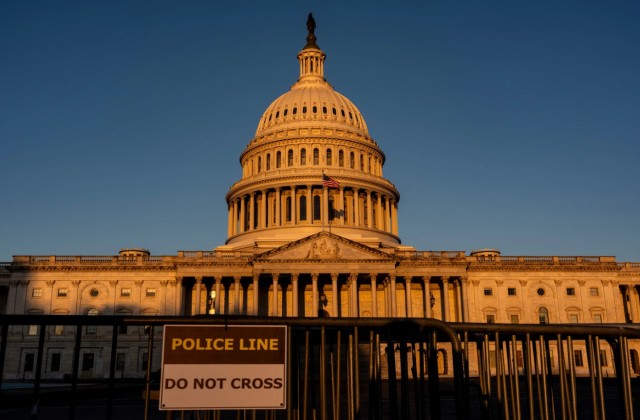
The Capitol is illuminated at dawn in Washington, Monday, October 6, 2025.
The ongoing U.S. government shutdown has entered its second week, and health care subsidies have become the central sticking point dividing Congress. Democrats and Republicans remain locked in a political deadlock, with neither side willing to compromise as millions of Americans brace for rising health insurance costs.
Democrats insist that extending Affordable Care Act (ACA) subsidies is non-negotiable. They argue the move is crucial to protect families from premium hikes set to hit early next year. Republicans, however, see the moment as an opportunity to reform — or even roll back — the ACA entirely.
Democrats Stand Firm on Health Care Subsidies
Democrats are making health care the cornerstone of their strategy to reopen the government. They believe extending ACA subsidies resonates strongly with the public, especially as more Americans rely on them for affordable insurance.
Since the subsidies were introduced in 2021 during the COVID-19 pandemic, they have helped a record 24 million Americans gain coverage. Democrats warn that without renewal, millions could face higher premiums in 2026. They also argue that public opinion is on their side, citing polls showing strong support for maintaining the subsidies.
Senate Majority Leader Chuck Schumer stated, “The American people feel deeply about solving this health care crisis. Every poll shows they want action — and they know who’s responsible for the gridlock.”
GOP Divided Over the Future of Obamacare
Within the Republican ranks, opinions are divided. Some lawmakers want to extend subsidies temporarily, while others view this as the perfect opportunity to challenge the Affordable Care Act.
Texas Representative Chip Roy has been vocal, urging fellow Republicans not to back down. “The pandemic is over,” he wrote. “If Republicans govern by poll and fail to seize this moment, they will own it.”
Others, like Florida Senator Rick Scott, echo that sentiment. “The whole problem with all of this is Obamacare,” he said, insisting that any deal must include reforms.
Still, not all Republicans share the hardline view. Missouri Senator Josh Hawley admitted that Congress must act soon. “I’m willing to consider reforms, but we have to do something before open enrollment begins,” he said.
Even Representative Marjorie Taylor Greene acknowledged the political and personal stakes, revealing that her own family’s premiums would double if the tax credits expire. “I’m not a fan of Obamacare,” she said, “but I can’t ignore what my constituents — and my own children — are facing.”
Trump and GOP Leaders Hesitant to Move
Former President Donald Trump, whose influence remains strong among Republicans, sent mixed signals. Initially suggesting talks were underway with Democrats, he later clarified on social media, “I am happy to work with Democrats on their failed health care policies, but first they must reopen the government.”
Republican leaders appear to be waiting for the White House’s position. Senate Minority Leader John Thune admitted there “may be a path forward” but said progress depends largely on Trump’s stance.
House Speaker Mike Johnson, meanwhile, has remained noncommittal. “Obamacare is not working,” he said. “We’re trying to fix it.”
Bipartisan Efforts Struggle to Gain Ground
Amid the stalemate, a handful of senators from both parties are exploring compromise options. Senator Mike Rounds proposed extending subsidies for a year before phasing them out, while Senator Susan Collins suggested advancing bipartisan spending bills alongside a health care review.
However, Democrats want firm guarantees — not promises — and Republicans demand structural reforms before any extension. The result: no breakthrough in sight.
Independent Senator Angus King, who caucuses with Democrats, warned he might shift his stance if Republicans fail to show genuine intent to solve the health care crisis. “We need real evidence, not vague assurances,” he said.
Stalemate Threatens Millions of Americans
As the shutdown drags on, the political fight over health care is having real-world consequences. Federal workers remain unpaid, and millions await clarity about their insurance costs for the coming year.
While both sides claim to represent the public’s best interests, their standoff threatens to push the health care system — and the government — deeper into uncertainty.
Unless Congress finds common ground soon, the debate over health care subsidies could turn from a political battle into a national crisis.