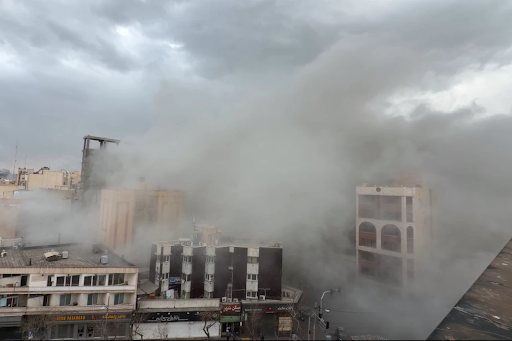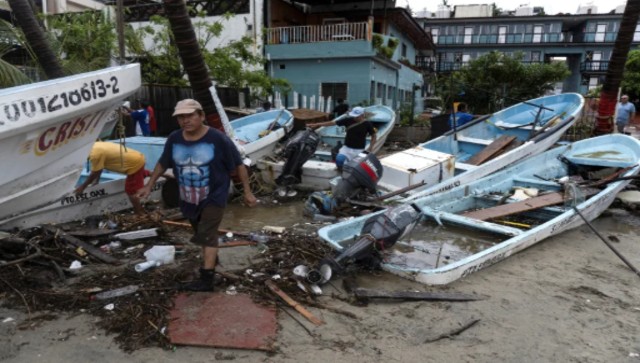
People assess damage on the beach in Puerto Escondido, Mexico, after hurricane Erick.
Mexico has been struck by its earliest powerful storm in recorded history. Hurricane Erick made a forceful landfall on Thursday morning, crashing into Oaxaca as a Category 3 hurricane. This marked a historic event—no major hurricane has hit the country so early in the year until now.
A Furious Arrival on the Coast
At around 6 a.m. CDT, Hurricane Erick struck land just 20 miles east of Punta Maldonado. According to the National Hurricane Center (NHC), it roared ashore with sustained winds of 125 mph. Earlier that morning, it had reached Category 4 strength with wind speeds peaking at 145 mph just off the coast.
Located roughly 100 miles east of Acapulco, the impact area is eerily close to the region battered by Hurricane Otis in 2023. The damage potential was high, not just because of the winds, but also due to the storm’s intense rainfall.
Record-Breaking Early Storm
Hurricane Erick has made history as the first major hurricane—Category 3 or higher—to hit Mexico before July. What makes this event even more alarming is how rapidly the storm intensified. Within just 24 hours, it grew from a tropical storm to a Category 4 hurricane.
Meteorologists say this phenomenon, known as rapid intensification, is becoming more frequent due to rising global temperatures linked to fossil fuel emissions. The storm's sudden strength caught many off guard.
The Aftermath Begins
Though Erick quickly weakened after making landfall, its heavy rains posed a major threat. Within hours, it was downgraded to a Category 1 hurricane. But the rainfall it brought could still be dangerous.
According to the NHC, parts of the Guerrero mountains could receive nearly 16 inches of rain. Coastal areas of Oaxaca and Guerrero may get up to 8 inches. Even Acapulco, though spared from the storm’s strongest winds, could see around 6 inches of rain.
Flash floods and deadly mudslides are now a real possibility in the days to come.
Acapulco's Painful Memories Resurface
For many in Acapulco, Hurricane Erick brought back traumatic memories of Hurricane Otis. Streets were filled with National Guard personnel, police, and emergency workers. Crews rushed to clear drainage canals and debris.
Acapulco’s port was shut down Tuesday evening. All movement in beach towns was suspended by 8 p.m. Wednesday, and schools were ordered closed on Thursday, as per Guerrero state Governor Evelyn Salgado.
The government activated 582 shelters across the state to house residents forced to leave their homes.
Authorities Warn of “Torrential” Rains
Mexico’s National Civil Defense Coordinator Laura Velázquez warned that Erick would bring “torrential” rains to Guerrero, Oaxaca, and Chiapas. These mountainous zones are particularly vulnerable to mudslides and overflowing rivers.
President Claudia Sheinbaum emphasized the seriousness of the situation, urging everyone to stay indoors and follow official instructions. Damage reports are still pending.
A Personal Account of Fear and Survival
Carlos Ozuna Romero, a resident of Acapulco, knows the danger all too well. He lost his beachside restaurant during Hurricane Otis. Now, he watches Erick's approach with unease.
“Authorities’ warnings fill us with fear and obviously make us remember everything we’ve already been through,” he said. As he stored furniture with his team, the memory of devastation was still fresh.

Residents try to drain water out of their houses following the passage of Hurricane Erick in Bahia Principal, Puerto Escondido, state of Oaxaca, Mexico, on June 19, 2025.
A Busy Start to the Season
Hurricane Erick is already the fifth named storm of the East Pacific hurricane season, which only began in mid-May. It’s also the second hurricane this early—a rare occurrence. Typically, the region doesn’t experience its second hurricane until mid-July.
Meanwhile, the Atlantic hurricane season remains quiet, with no named storms yet.
Final Thoughts
Erick's impact is a wake-up call. With the storm season just starting, its early arrival and strength show how climate shifts are changing weather patterns. Mexico now faces the dual challenge of recovery and preparing for what could be a turbulent season ahead.