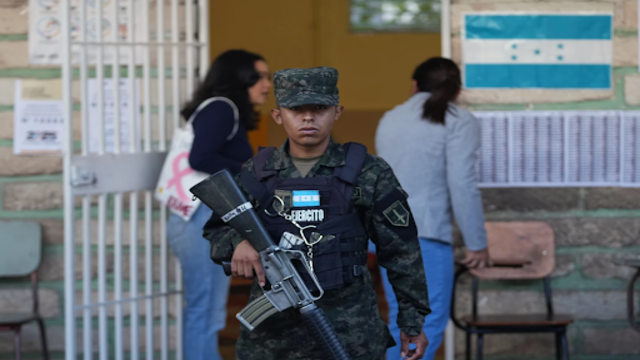
A soldier guards a polling station during general elections in Tegucigalpa, Honduras, Sunday, Nov. 30, 2025. Associated Press
Early results from the Honduran presidential election indicate a competitive battle between conservative contenders, with the governing LIBRE party trailing behind. The National Electoral Council released partial figures late Sunday, reflecting votes from about 34% of polling stations, setting the stage for what could become one of the country’s most contentious electoral showdowns.
Conservatives Take Early Lead
Initial data showed Nasry “Tito” Asfura of the National Party leading with 40.63% of votes. Close behind was Salvador Nasralla of the Liberal Party, securing 38.78%. Far behind, Rixi Moncada of the democratic socialist LIBRE party captured 19.59%, placing the ruling party at a disadvantage early in the count.
Asfura, a 67-year-old former mayor of Tegucigalpa, campaigned on a record of infrastructure development and a reputation for practical policymaking. His popularity in urban areas helped build a strong support base even before the vote.
U.S. Politics Shape the Election Atmosphere
The Honduras election took an unexpected turn days before voting when U.S. President Donald Trump publicly endorsed Asfura. Trump declared that Asfura was the only candidate his administration would work with and praised him for opposing “narco-communists.”
Trump’s involvement escalated further when he announced he would pardon former Honduran President Juan Orlando Hernández, currently serving a 45-year sentence in the United States for aiding drug traffickers.
The endorsement stirred debate but did little to sway many Honduran voters, many of whom insisted that U.S. statements would not influence their choices. However, Trump’s warning that Nasralla and Moncada could “turn Honduras into Venezuela” intensified political divides.
Nasralla Pushes Anti-Corruption Agenda
Despite multiple political alliances over the years, Salvador Nasralla, a 72-year-old sportscaster and longtime public figure, continued positioning himself as an outsider. His primary promise remained clear: combat corruption at all levels.
In the early count, Asfura had 530,073 votes, Nasralla had 506,316, and Moncada received 255,972, indicating a tight race between the two conservative candidates.
Disputes Over Election Integrity
Concerns about fairness overshadowed the final days of campaigning. The leading candidates repeatedly accused one another of manipulating the election, raising alarms among both local and international observers.
Moncada, LIBRE’s chosen successor to President Xiomara Castro, stated before the vote that she would not accept early tallies, alleging a coordinated attempt to alter the results. She urged supporters to remain vigilant until 100% of votes were counted.
On the other side, opposition members feared the governing party might use state resources to tilt the race in Moncada’s favor. Such distrust raised concerns about whether all candidates would accept the official results once they are released.
Voters Focus on Jobs and Security
Economic stability and public safety dominated voter concerns. While Honduras has seen improvements in unemployment and homicide rates under Castro’s administration, the country still holds Central America’s highest homicide rate. Many citizens continue to struggle with limited job opportunities.
Supporters of President Castro argue that she inherited deep socioeconomic challenges from Hernández, who was later extradited to the United States on drug trafficking charges. Despite modest progress, frustration with slow growth and persistent crime shaped voter sentiment.
A High-Stakes Election Beyond the Presidency
Alongside choosing a new president, Hondurans also voted for a fresh Congress and hundreds of local officials. The outcomes will directly influence the next administration’s ability to govern and implement reforms.
With conservative candidates leading in early results and tensions rising over election credibility, Honduras faces a pivotal moment. As counting continues, the nation waits to see whether political calm or deeper conflict will follow this closely watched presidential race.