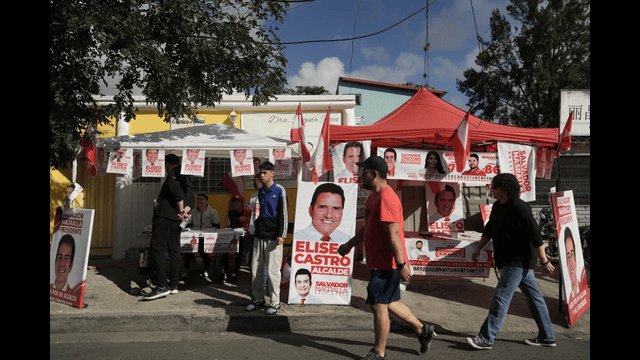
People walk past a candidate’s stand with campaign materials during general elections in Tegucigalpa, Honduras, Sunday, Nov. 30, 2025.
The race for Honduras’ next president tightened sharply on Monday, as partial results showed a neck-and-neck contest between Nasry Asfura of the National Party and Salvador Nasralla of the Liberal Party. While votes continued to be counted, a fierce debate unfolded nationwide over one unexpected factor in the election — Donald Trump’s impact.
Trump’s Influence Becomes a Central Election Keyword
In Tegucigalpa’s bustling center, 52-year-old food vendor Reyna Vega reflected the mood of many Hondurans. She voted for Asfura, partly because rising food prices pushed her to seek change, and partly because Trump’s endorsement made her believe Asfura could restore stability.
For others, Trump’s comments forced last-minute reconsideration. Some undecided voters confessed that the former U.S. president’s warnings about LIBRE candidate Rixi Moncada, and his comparisons to Venezuela, played a role in influencing their choices.
Analysts Say Trump Shifted the Momentum
Civil society leader Juan Carlos Aguilar said Trump’s involvement helped Asfura close the gap with Nasralla.
He called Trump’s remarks “transcendental,” arguing they nudged voters who were leaning toward Nasralla to switch on Election Day.
Supporters of Nasralla also acknowledged the effect. San Pedro Sula resident Fabricio Paz Munguía said Trump’s statements forced many Hondurans to “think harder about what was good for the country.”
Election Results Still Too Close to Call
By Monday afternoon, the National Electoral Council announced that 57% of polling stations had reported. At that stage, Asfura led Nasralla by just 515 votes, each receiving around 39% support.
The presidential race in Honduras is decided by whoever wins the most votes — even without crossing 50%.
However, further counting faced delays after one of the results websites went offline. Both candidates urged patience.
Asfura said, “We’re calm, the data will come out,” while Nasralla expressed confidence that votes from northern Honduras — his stronghold — would push him ahead.
Voters United on One Goal: Remove LIBRE
Even Hondurans backing opposing conservative candidates shared one sentiment — a desire to remove LIBRE, the governing democratic socialist party.
Vega’s son, Eddy Xavier, said he didn’t care which conservative won. “What we didn’t want was LIBRE,” he explained.
Although LIBRE under President Xiomara Castro oversaw declining murder rates and an improving economy, many Hondurans felt nostalgic for the National Party era.
Trump’s Promise to Pardon Hernández Sparks Reactions
Trump’s surprise announcement that he would pardon former President Juan Orlando Hernández, currently serving a 45-year U.S. sentence for drug trafficking, stirred further emotions.
First-time voter Jair Ávila, 20, openly admitted the promise influenced him, saying life felt “easier” when Hernández was president.
He recalled cheaper food, lower fuel prices, and government housing giveaways, saying, “We were better off with him.”
Some voters even welcomed the idea of Hernández returning to Honduras, believing he had “learned from past mistakes.”
Honduran Migrants Hope for Protection
Trump’s endorsement of Asfura also raised hopes among families with relatives in the United States.
Vega, whose relatives send crucial support from abroad, said she hoped Trump’s backing might shield Honduran migrants from mass deportations if he wins the U.S. presidency again.
LIBRE Refuses to Give Up
The tight race raised concerns about post-election tensions. Although Moncada trailed by 20 percentage points, she refused to concede.
At a rally Monday night, she told supporters, “The election is not lost,” accusing the leading parties of setting a “trap” and urging voters to stay vigilant until every ballot is counted.
Honduras Waits for Answers
With partial results showing razor-thin margins and both leading candidates expressing confidence, Honduras now faces a tense wait for the final tally.
Trump’s influence — as an election keyword and a political force — continues to dominate national discussions, amplifying uncertainty in a country already deeply divided.
For now, Honduras watches and waits as a historic and unpredictable election moves toward its final decision.