

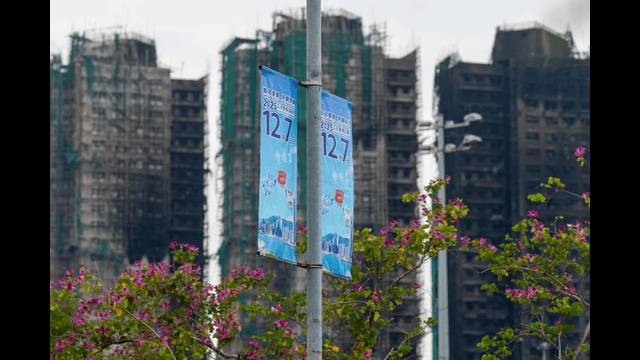
Banners promoting the Hong Kong legislative council general elections on Wednesday, Dec 3, 2025.
Hong Kong heads into a pivotal legislative election on Sunday, but the vote comes at a tense moment. A catastrophic fire that killed at least 159 people only 11 days earlier has intensified scrutiny of the city’s “patriots-only” governance system, raising doubts about oversight, accountability, and public trust.
Voter turnout will be closely watched as a measure of public confidence. Many residents, discouraged by years of political crackdowns, now question both the government’s handling of the fire and the broader direction of Hong Kong’s political structure.
Deadliest Fire in Decades Deepens Public Concern
The blaze, which engulfed seven high-rise towers, was Hong Kong’s worst fire since 1948. Although public protests are rare due to strict security laws, concerns about building safety, maintenance oversight, and the government’s response have circulated in private groups and online discussions.
The fire abruptly halted the government’s push to boost turnout. The tragedy exposed systemic weaknesses and left many residents questioning leadership priorities—just days before the election.
Major Turnover Ahead of the Election
This year’s election sees an unusual shift: nearly 40% of incumbent lawmakers are stepping aside. Many familiar faces, including experienced and mildly outspoken politicians, have chosen not to run again.
Government figures say the change reflects normal renewal. But analysts suggest Beijing prefers newer lawmakers who align more closely with its national agenda. Several candidates with mainland business ties and members of China’s parliament are now entering the race, signaling deeper central-government influence.
Beijing’s Grip Tightens After Electoral Overhaul
The 2021 electoral overhaul reshaped Hong Kong’s Legislative Council. The number of directly elected seats dropped from 35 to 20, while 40 seats are now chosen by a mostly pro-Beijing committee. Another 30 seats are filled through professional and business sectors.
All candidates must pass strict security vetting. As a result, pro-democracy politicians have vanished entirely from the legislature. Many were arrested under the 2020 national security law.
While pro-Beijing leaders praise the system’s “efficiency,” surveys indicate public concern about diminishing debate quality and limited representation.
Surge in Candidates With Mainland Links
An investigation found 26 of 161 candidates hold roles in Chinese-funded enterprises—almost double the number from the previous election. Many work for state-owned companies, raising questions about independence and priorities.
Sixteen candidates are delegates to China’s top legislature, and another 13 serve in Beijing’s political advisory body. Experts say these candidates are more aligned with Beijing’s national agenda than with localized concerns from Hong Kong residents.
Political scholar John Burns notes that central authorities now appear to prefer younger candidates, fewer outspoken voices, and people with closer institutional ties to the mainland.
Candidates Defend Dual Roles
Despite growing scrutiny, officials maintain that working for Chinese-funded institutions does not conflict with legislative duties. Hong Kong leader John Lee rejected claims of interference, saying Beijing’s interest in the election is justified.
Several candidates argue that their roles in mainland-related companies help bridge national policies and Hong Kong’s development goals. Others, including Olympic athlete Vivian Kong, have faced questions but passed the vetting process.
Turnout Concerns After 2021’s Record Low
Turnout in 2021 hit a historic low of 30.2%. Officials have expanded polling stations, encouraged civil servants to vote, and offered support to elderly and disabled residents to raise participation.
But analysts predict turnout may fall even further. The deadly fire disrupted voter outreach efforts, and many former pro-democracy supporters remain disengaged. Some pro-government voters may also hesitate due to the fire’s exposure of systemic failures.
Authorities have even arrested individuals for allegedly discouraging voting or damaging election materials, highlighting the tense atmosphere.
A Crucial Test for Public Confidence
Sunday’s vote is more than a legislative contest—it is a gauge of public sentiment, governance credibility, and Beijing’s influence over Hong Kong’s political future. The fire has reshaped the narrative, turning what was meant to be a showcase of “high-quality democracy” into a moment of reckoning.
Whether the government can overcome public skepticism—or whether turnout sinks even lower—will define the impact of this election on Hong Kong’s evolving political landscape.













