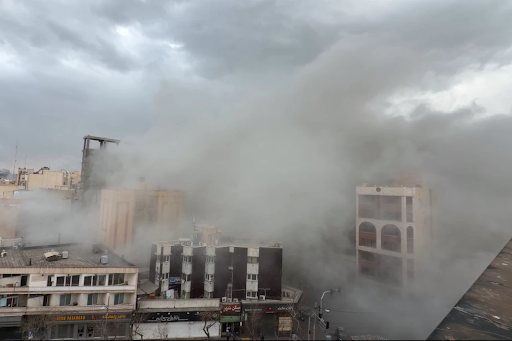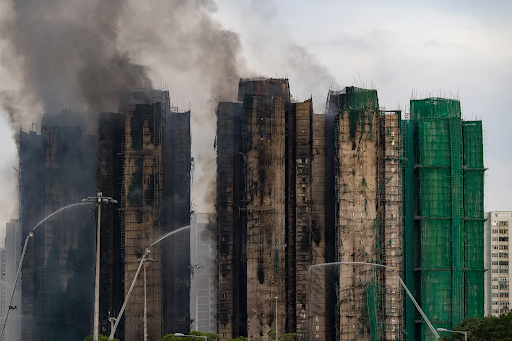
Firefighters work to extinguish a fire that broke out Wednesday at Wang Fuk Court, a residential estate in the Tai Po district of Hong Kong’s New Territories, Thursday, Nov. 27, 2025.
Thick smoke continued to rise over Hong Kong’s Tai Po district on Thursday as firefighters battled a massive tower fire for a second day. The tragedy, now one of Hong Kong’s deadliest modern fires, has killed at least 44 people and left dozens injured.
Deadly Fire Engulfs Hong Kong Towers
The fire erupted on Wednesday afternoon at the Wang Fuk Court complex, a cluster of eight residential towers under renovation. Within hours, the blaze had spread across seven buildings, fueled by scaffolding, construction materials, and strong winds.
By Thursday morning, officials confirmed that four towers were finally under control, but thick smoke still poured from the burning structures. One firefighter was among the victims. At least 62 people were injured, many suffering from severe burns and smoke inhalation.
Manslaughter Arrests After Hong Kong Tower Fire
As rescue teams worked nonstop, authorities arrested three men connected to the renovation work — two directors and an engineering consultant from a construction company.
Police said the suspects may have shown “gross negligence”, which contributed to the rapid spread of the Hong Kong tower fire.
Investigators found flammable Styrofoam attached to window frames near elevator lobbies. The material, which burns easily, may have worsened the blaze. Authorities also suspect that some external wall materials failed fire resistance standards, raising questions about construction safety at the site.
Security Secretary Chris Tang said the government will “investigate all materials thoroughly.”
How the Hong Kong Tower Fire Spread So Fast
The fire reportedly began on the external scaffolding of a 32-story tower. The flames then climbed the bamboo scaffolding and construction netting, which acted as fuel, allowing the fire to jump inside the building and then spread to nearby towers.
Windy weather further intensified the fire, making it harder for firefighters to contain the blaze.
Deputy Fire Director Derek Armstrong Chan described the conditions as dangerous and unpredictable.
“Debris and scaffolding are falling. Temperatures inside the buildings are extremely high,” he said.
Rescue teams struggled to enter the burning floors due to structural risks and intense heat.
Residents Trapped and Hundreds Missing
Wang Fuk Court houses nearly 4,800 residents, many of them elderly. The complex, built in the 1980s, was undergoing major renovation at the time of the fire.
Around 900 residents were evacuated to temporary shelters overnight. However, as of midnight, 279 people were still reported missing, according to Chief Executive John Lee.
Terrifying accounts emerged from survivors’ families. One man said he told his mother to escape, but she had to return to her flat because smoke filled the smoke-filled corridor was instantly.
Search and rescue operations continued through Thursday morning, though the exact number of rescued individuals was still unclear.
Government Response and Election Concerns
Chief Executive John Lee called the Hong Kong tower fire a national priority. He announced that the government would suspend all promotion for the December 7 Legislative Council elections while focusing on the disaster response.
He did not rule out a possible postponement of the elections, saying decisions would be made “in a few days.”
Chinese President Xi Jinping sent condolences to the victims’ families and the firefighter who died, urging authorities to work quickly to minimize further losses.
Worst Hong Kong Fire in Decades
The Hong Kong tower fire marks the city’s deadliest blaze in decades. The last major tragedy of a similar scale occurred in 1996, when 41 people died in a commercial building fire in Kowloon that burned for 20 hours.
As firefighters continue to extinguish the remaining flames, questions about safety standards, material use, and renovation oversight are expected to dominate Hong Kong’s discussions in the days ahead.