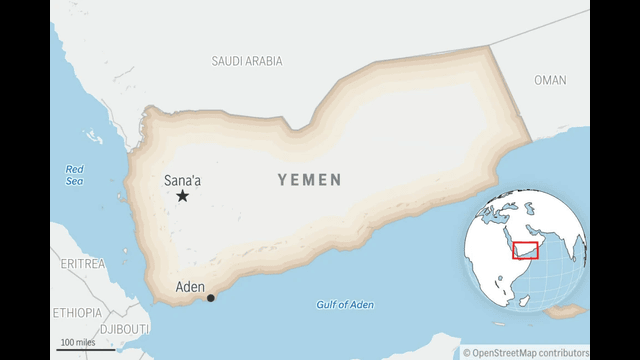
This is a locator map for Yemen with its capital, Sanaa.
Yemen’s Houthi rebels have hinted at suspending their attacks on Israel and commercial ships in the Red Sea, signaling a temporary pause amid a fragile ceasefire in Gaza.
The development marks one of the clearest signs yet that the group is pulling back from a campaign that has disrupted vital global trade routes since late 2023.
Houthis Signal a Pause in Operations
In a letter addressed to Hamas’ Qassam Brigades and released late Monday, the Houthis declared their intention to cease operations. The message emphasized that the decision was linked to the current calm in Gaza.
“We are closely monitoring developments,” the letter stated. “If the enemy resumes its aggression against Gaza, we will return to our military operations deep inside the Zionist entity and reinstate the ban on Israeli navigation in the Red and Arabian Seas.”
Although no formal declaration of a ceasefire has been made by the Houthis, the message serves as the clearest public signal yet of a pause in hostilities.
Background of the Houthi Campaign
The Iran-backed Houthis, who control much of northern Yemen, began targeting Israeli-linked ships and Western vessels in late 2023. Their stated aim was to pressure Israel and its allies amid the Gaza conflict.
The attacks forced global shipping companies to reroute vessels around the Cape of Good Hope, significantly increasing travel time and costs. Several ships were hit, and at least one was seized during the campaign, raising concerns over maritime security in one of the world’s busiest trade corridors.
Link to Gaza Ceasefire
The apparent halt in Houthi attacks coincides with a tenuous ceasefire in Gaza, where weeks of conflict have left widespread devastation. The group’s actions have long been tied to developments in the Israel-Hamas war, with the Houthis framing their assaults as part of a broader effort to support Palestine.
Analysts say the rebels may be pausing attacks to assess the situation in Gaza and to avoid international backlash, particularly after growing military pressure from the United States and its allies, who have repeatedly struck Houthi targets in Yemen in response to Red Sea attacks.
Strategic Shift or Temporary Pause?
Experts caution that the Houthis’ statement may not mark a permanent end to hostilities. Their conditional language — linking future actions to any renewed “aggression” in Gaza — suggests the group is maintaining a strategic pause rather than a full withdrawal.
“The Houthis are signaling flexibility, not surrender,” said one regional analyst. “They’re keeping the option open to resume attacks if fighting escalates again in Gaza.”
This approach allows the Houthis to retain influence while avoiding further strikes from Western forces, which have intensified in recent months.
Global and Regional Implications
If the pause holds, it could ease tensions in the Red Sea, a key route for global oil and commercial shipping. The conflict had already disrupted supply chains and driven up insurance costs for vessels passing through the region.
However, uncertainty remains. Many observers note that Houthi actions often align with broader Iranian regional strategies, meaning future decisions could depend on Tehran’s assessment of the Gaza ceasefire and its relations with Israel and Western powers.
Waiting for Confirmation
So far, the Houthis have not issued an official confirmation ending their campaign. Their media channels have been quieter in recent days, reinforcing speculation of a pause.
Regional governments and maritime authorities continue to monitor Red Sea activity closely, wary of a sudden return to hostilities if tensions flare again in Gaza.
For now, the Houthis’ message to Hamas offers a rare moment of calm — but one that could change swiftly if violence resumes in the region.