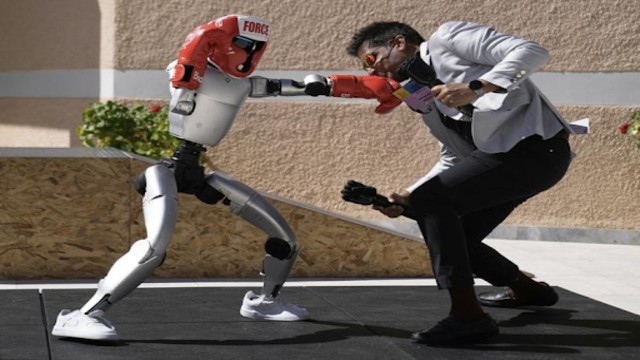
The Unitree G1 robot plays boxing with Aadeel Akhtar CEO and Founder of Psyonic at the first International Humanoid Olympiad at the Olympic Academy, in ancient Olympia, Greece, Monday, Sept. 1, 2025. (AP Photo)
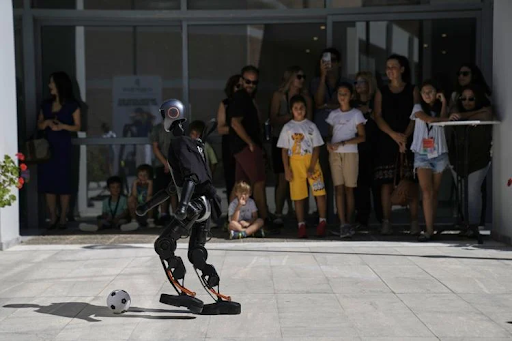
At Ancient Olympia, the birthplace of the Olympic Games, humanoid robots recently showcased their skills in a spectacle that was equal parts futuristic and experimental. Robots kicked soccer balls, boxed in shadows, and even attempted archery. Yet, their stiff movements and frequent pauses for battery changes revealed the long road ahead before they can tackle everyday household chores.
Beyond the Dazzle: When Will Robots Help at Home?
While artificial intelligence continues to soar with applications like ChatGPT, humanoid robots remain far behind. Their creators debated whether these machines would one day fold laundry or clean kitchens.
Greek academic and startup founder Minas Liarokapis, who organized the International Humanoid Olympiad, believes homes will be the last frontier. “I really believe humanoids will first go to space and then to houses,” he said. According to him, it will take at least a decade before humanoids can complete domestic tasks with precision.
The four-day event at Olympia brought together researchers, developers, and visionaries from around the world. The goal: measure progress and discuss the next phase in robotics.
The Data Dilemma
Artificial intelligence thrives on the internet’s vast resources of text, images, and videos. Humanoids, however, lack the same training advantage. Collecting real-world data for them is slow, costly, and technically challenging.
By some estimates, humanoid robots are 100,000 years behind AI in terms of data learning. Ken Goldberg, a robotics expert from the University of California, Berkeley, argues that simulations alone won’t close the gap. He suggests blending “old-fashioned engineering” with real-world training so robots can learn while performing useful work, from sorting packages to driving taxis.
The Push for Partnerships
Luis Sentis, professor at the University of Texas at Austin and co-founder of Apptronik, believes collaboration is the key. He noted that partnerships between researchers, tech firms, and manufacturers are already attracting billions in investment. “These synergies are happening very quickly,” Sentis said. “I see problems being solved day by day.”
Developers at Olympia also pitched innovative solutions. Aadeel Akhtar, founder of prosthetics company Psyonic, introduced a bionic hand that provides sensory feedback. Already tested on humans, it could generate data transferable to robots.
Meanwhile, Australian biotech firm Cortical Labs is exploring biological computing. Their chips use living brain cells capable of learning and adapting, potentially giving robots more human-like thinking abilities.
A New Arena for Competition
Event organizers designed challenges that robots could realistically attempt. Some participants tried shot put, while discus and javelin were deemed too ambitious. Patrick Jarvis, co-founder of Acumino, said the Olympiad’s mission is to provide “honest validation” of robotics progress.
East and West Approaches Differ
The event also highlighted cultural contrasts. Chinese companies frequently display their robots at public events, while many U.S. firms prefer slick promotional videos that avoid showing flaws. Still, exceptions stand out. Tesla’s Optimus prototype walked stiffly onstage in 2022, while Boston Dynamics’ robot dogs famously danced on America’s Got Talent. One even collapsed mid-routine — a reminder of both progress and limitation.
As the Olympiad closed, one truth stood clear: humanoid robots are advancing, but their journey to everyday usefulness remains a marathon, not a sprint.