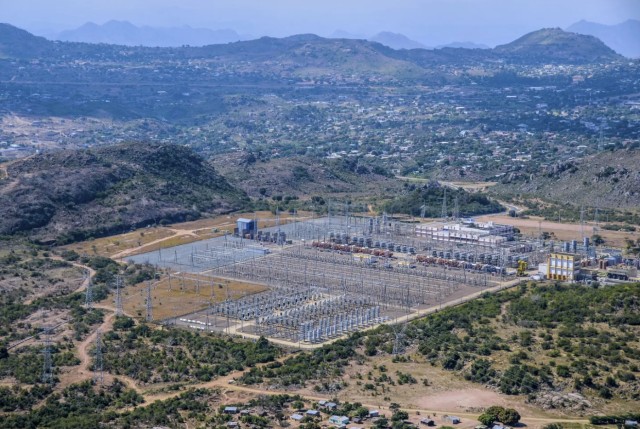
Aerial view of a substation, in Songo, Mozambique, Saturday, July 19, 2025.
Electricity is changing lives in Mozambique. Just ask Hermínio Guambe. Once a village barber working without power, he now uses hair dryers, while his community pharmacy stocks refrigerated medicines. Jobs have followed as small businesses thrive.
“Electricity isn’t just light, it’s a chance,” said World Bank President Ajay Banga, who recently visited Mozambique.
The nation has now secured World Bank support for the $6 billion Mphanda Nkuwa hydroelectric project, the largest energy investment in southern Africa in half a century.
Mozambique’s Ambitious Energy Goal
Mozambique, among the world’s poorest nations, wants to bring electricity to all 33 million citizens by 2030. Most live in rural areas, where access to reliable power remains limited. The plan focuses heavily on renewable energy, particularly hydropower and solar.
Progress has been significant. Electricity access in Mozambique has jumped from 31% in 2018 to 60% in 2024. State utility Electricidade de Moçambique (EDM) connected 563,000 households last year and aims to reach 600,000 more in 2025.
“Mozambique already exports power and has vast untapped potential in hydro, gas, and solar,” Banga noted.
A Regional Powerhouse in the Making
The Mphanda Nkuwa hydroelectric plant will be built along the Zambezi River, 60 kilometers downstream from the Cahora Bassa dam. Once completed in 2031, it is expected to generate 1,500 megawatts — vital for a region facing a 10,000-megawatt energy shortfall.
The project won’t be financed directly by the World Bank. Instead, it will be developed by TotalEnergies, Électricité de France, and Mozambique’s Hidroeléctrica de Cahora Bassa. The World Bank’s role includes concessional funding, transmission support, and risk guarantees.
This model reflects a wider shift in development finance, with emphasis on private investment instead of donor aid.
Hydropower: Africa’s Untapped Resource
Mozambique’s project is part of a broader continental push. Ethiopia is completing its $4 billion Grand Renaissance Dam, while Congo’s Inga 3 project also promises regional power exports.
Despite these efforts, hydropower remains largely unused in Africa. Around 90% of potential capacity lies untapped, according to the World Bank and International Hydropower Association.
For Mozambique, geography adds another challenge. “Our country is big. Extending the national grid everywhere is difficult,” EDM chairman Joaquim Ou-Chim explained. That’s why off-grid solar solutions are expanding, currently accounting for about 10% of electricity access.
Balancing Big Projects and Local Needs
Not everyone is convinced mega-dams are the full answer. Energy consultant Evaristo Cumbane believes smaller, local projects should complement large-scale hydropower.
“Mozambique has rivers, sunshine, wind, and long coastlines. Rural areas need localized energy solutions,” he said.
Cumbane also raised financial concerns. Mozambique’s public debt hit $17 billion in early 2025, with record repayments in 2023. “The World Bank is not here as a donor. These are business deals,” he warned.
Hope and Challenges Ahead
Mozambique’s journey has been difficult. Since independence in 1975, it has faced civil war, political unrest, and an Islamist insurgency in the north that stalled a $20 billion gas project.
Still, citizens see electricity as a lifeline. In one Maputo neighborhood, 38-year-old Aurélio Arlindo has lived years without power. New poles now rise near his home.
“It’s really coming. I am just waiting,” he said, dreaming of opening a cold drinks stall once the lights switch on.
For barbers like Guambe and entrepreneurs across the country, the Mphanda Nkuwa project is more than an energy initiative. It represents the possibility of a brighter future for Mozambique and the region.