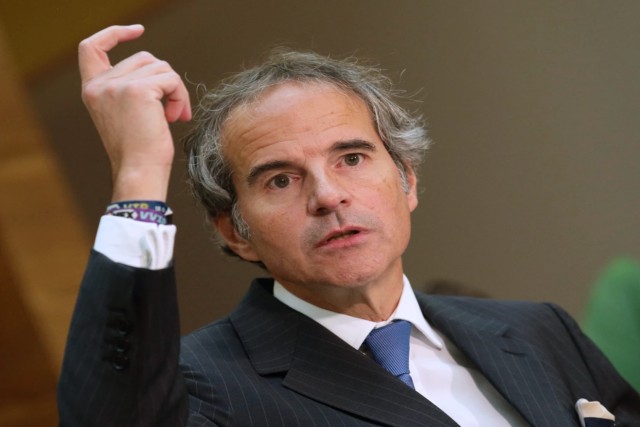
International Atomic Energy Agency (IAEA) Director General, Rafael Grossi, addresses the media after arriving at the Vienna International Airport in Schwechat, Austria, May 7, 2024.
The International Atomic Energy Agency (IAEA) has warned that Iran’s cooperation with nuclear inspectors is still incomplete. Director General Rafael Grossi described the situation as “a work in progress” even as European powers move closer to reimposing sanctions on Tehran.
Despite limited progress, unresolved questions remain over Iran’s nuclear program, fueling diplomatic tension between Iran, Europe, and the United States.
Inspectors Back in Iran, But Access Still Limited
For the first time since the June Iran-Israel conflict, inspectors have been allowed back into Iran. Grossi welcomed the return but stressed that access to key nuclear sites remains restricted.
He confirmed that inspectors had re-entered the Bushehr nuclear power plant, yet other sensitive facilities are still off-limits. Many of those sites were targeted during U.S. and Israeli airstrikes earlier this year.
Grossi emphasized that important verification work must continue to ensure Iran’s nuclear activities remain transparent. “We still need to clarify a number of things,” he told reporters.
European Powers Push for Sanctions
Leaders from Germany, France, and the United Kingdom—collectively known as the E3—have issued repeated warnings. They argue Iran has failed to comply with the 2015 nuclear deal and could face renewed U.N. sanctions.
The E3, along with the U.S., set an August 31 deadline for Tehran. Iran must resume negotiations, grant inspectors full access, and account for more than 400 kilograms of enriched uranium. Failure could trigger the “snapback mechanism,” automatically restoring sanctions under the nuclear deal.
Despite ongoing talks in Switzerland, European diplomats admitted discussions with Iran ended without a breakthrough.
U.S. and Europe Unite Against Nuclear Escalation
U.S. Secretary of State Marco Rubio spoke with his European counterparts this week. All reiterated a firm commitment: Iran must never acquire nuclear weapons.
American officials also highlighted the importance of IAEA inspections and monitoring. Without transparency, they argue, global nuclear safety remains at risk.
The U.S. has long accused Iran of seeking nuclear weapons capability. While Tehran insists its program is peaceful, it remains the only non-nuclear state enriching uranium at near weapons-grade levels.
Iran Signals Diplomacy, But Distrust Grows
Iranian Foreign Minister Abbas Araghchi confirmed IAEA inspectors observed fuel replacement at Bushehr. However, he downplayed the significance, saying it did not mean wider access would be granted.
Deputy Foreign Minister Kazem Gharibabadi posted on X that Iran “remains committed to diplomacy.” He urged Europe to “make the right choice” and give talks more time.
Still, critics argue that Iran’s actions show little willingness to compromise. Its uranium enrichment activities and refusal to grant full site access remain sticking points.
Grossi Under Police Protection Amid Threats
Meanwhile, Grossi himself faces personal risks. The IAEA chief is under the protection of Austria’s elite Cobra police unit following threats allegedly linked to Iran.
“It’s very regrettable that some people threaten the lives of international civil servants,” Grossi said. Despite the threats, he pledged to continue his mission.
The Wall Street Journal reported that Grossi, an Argentine diplomat, has raised the IAEA’s global profile. His visits to war zones, including Ukraine, and his strong stance on Iran have made him a high-profile target.
Tensions at a Critical Point
The nuclear standoff is reaching a decisive phase. Israel’s June strikes against Iranian nuclear sites, backed by U.S. support, marked a turning point. Soon after, the IAEA censured Iran for noncooperation—the first such move in two decades.
Iranian officials responded with sharp rhetoric, even demanding Grossi’s arrest if he returned. Tehran continues to accuse the IAEA of bias and collusion with its adversaries.
As the sanctions deadline nears, the international community watches closely. Whether diplomacy prevails or sanctions return may shape the future of Iran’s nuclear ambitions—and global security.