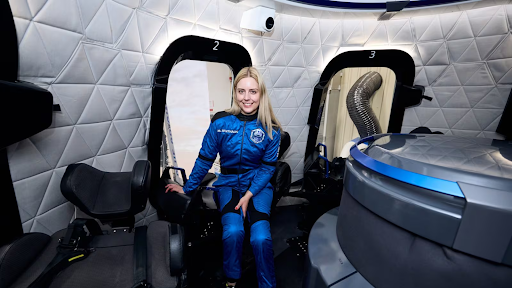
A handout image from Blue Origin shows German engineer Michaela Benthaus seated inside a practice space capsule at the company’s launch site in Van Horn, Texas, on Dec. 15, 2025. Benthaus trained there as she prepared to become the first wheelchair user to travel into space. AP
A German engineer who uses a wheelchair reached space for the first time on Saturday, marking a major moment for inclusion in space travel. Michaela Benthaus lifted off from West Texas on a short rocket flight and floated freely in weightlessness, leaving her wheelchair behind on Earth.
Benthaus joined five other passengers on the flight operated by Blue Origin, the private space company founded by Jeff Bezos. Her trip made her the first wheelchair user to travel into space.
From Tragedy to Triumph
Seven years ago, a mountain biking accident left Benthaus with a severe spinal cord injury. She lost the ability to walk and had to adjust to life in a wheelchair. At the time, space travel felt impossible.
“I never really thought that going on a spaceflight would be a real option for me because even as like a super healthy person, it’s like so competitive, right?” she said before the launch.
Despite the setback, Benthaus continued her work as an engineer and joined the European Space Agency’s graduate trainee program in the Netherlands. Her passion for space never faded.
A Short Flight, A Huge Impact
The rocket flight lasted about 10 minutes and offered more than three minutes of weightlessness. Benthaus said she laughed the entire way up and tried to flip upside down while floating.
“It was the coolest experience,” she said shortly after landing.
The spacecraft required only small changes to support her needs. The capsule already included features that made movement easier. The team added a transfer board so she could move from the hatch to her seat. After landing, staff rolled out a carpet so she could reach her wheelchair right away.
Support From Fellow Crew
Hans Koenigsmann, a retired space executive born in Germany, joined Benthaus on the flight. He helped plan the mission and supported her during training and landing. He also served as her emergency helper.
Benthaus trained for the experience through earlier flights that created brief moments of weightlessness. She also took part in a simulated space mission in Poland. When Koenigsmann first mentioned the idea of spaceflight, she thought he misunderstood her situation. He had not.
A Message Beyond Space
This mission had no official role from the European Space Agency. Still, it came during a time when space agencies show growing interest in inclusion. Earlier this year, the agency approved a reserve astronaut with a disability for a future space station mission.
Benthaus said she wants her flight to change attitudes on Earth as well as in space.
“You should never give up on your dreams, right?” she said after landing.
She hopes her journey opens doors for others with disabilities and proves that limits can change.