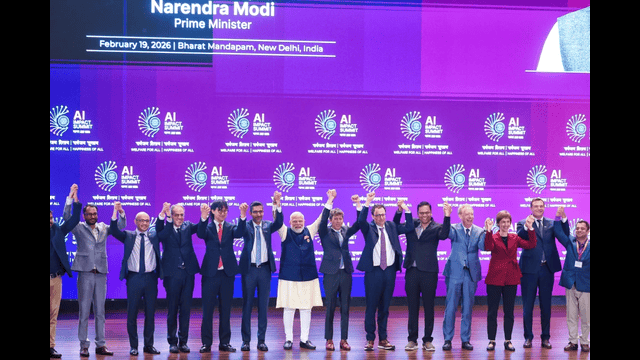
India’s Prime Minister Narendra Modi, seventh left, poses for photographs with chief executive officers of various AI groups during the AI Summit in New Delhi, India, Thursday, Feb. 19, 2026.
Prime Minister Narendra Modi used the India AI Summit to project a bold technology vision.
He said India wants to design artificial intelligence domestically and deploy it worldwide.
The announcement signals India’s ambition to become a central artificial intelligence hub.
Speaking in New Delhi, Modi highlighted India’s expanding digital ecosystem and global technology partnerships.
He urged innovators to build solutions locally while delivering benefits to humanity everywhere.
India Pushes Global Artificial Intelligence Hub Strategy
Modi stressed that artificial intelligence must support inclusive growth and shared global progress.
He argued that AI development should not remain concentrated among a few wealthy nations.
Instead, he called for wider participation, especially from emerging economies and developing regions.
India wants to position itself between advanced markets and the Global South.
Officials believe the country’s digital systems prove scalable technology can remain affordable.
They often cite digital identity platforms and instant payment networks as successful models.
According to Modi, democratizing AI will help expand opportunity, education, and economic access globally.
Global Leaders Join India AI Summit Discussions
The India AI Summit gathered several influential global voices and technology executives.
French President Emmanuel Macron joined discussions on international cooperation and responsible technology governance.
Google chief Sundar Pichai also addressed the forum alongside senior policymakers.
U.N. Secretary-General António Guterres proposed a major international AI support initiative.
He called for a three-billion-dollar global fund supporting AI infrastructure in poorer countries.
The proposal focuses on training, computing access, and shared data resources.
Guterres warned that AI’s future cannot depend on a handful of governments or billionaires.
Tech Firms Signal Strong Investment Interest
India’s massive digital population continues attracting global artificial intelligence investment plans.
The country now has nearly one billion internet users and rapidly expanding online services.
Major companies have already announced long-term infrastructure commitments across India.
Microsoft recently pledged seventeen-and-a-half billion dollars for cloud and AI expansion.
Google earlier committed fifteen billion dollars and plans its first AI hub locally.
Amazon also promised thirty-five billion dollars toward AI-driven digital growth by 2030.
India is simultaneously seeking roughly two hundred billion dollars in new data center investments.
Partnerships and Industry Meetings Gain Attention
During the summit, Modi held closed-door meetings with leading technology executives.
Many firms outlined investment roadmaps and endorsed principles supporting inclusive multilingual artificial intelligence.
OpenAI chief Sam Altman confirmed cooperation with India’s Tata Group on future AI projects.
The partnership includes developing data center infrastructure and supporting broader digital capacity.
Altman said widespread access to artificial intelligence represents the safest and fairest development path.
A group photo from the meeting spread widely online.
Observers noticed Altman and Anthropic CEO Dario Amodei briefly hesitated during a symbolic hand-holding moment.
Altman later joked he simply misunderstood what participants were supposed to do.
India Still Faces Artificial Intelligence Development Challenges
Despite investment momentum, India still lacks a globally dominant large-scale AI model.
American and Chinese firms currently lead advanced foundation model development.
Experts point to multiple structural barriers slowing domestic AI breakthroughs.
India needs stronger semiconductor supply chains and expanded high-performance computing infrastructure.
Language diversity also complicates training datasets across hundreds of regional languages.
Officials acknowledge these hurdles but insist rapid investment will narrow the technology gap.
Organizational Issues Cloud Parts of the Summit
The India AI Summit also experienced logistical setbacks during the opening days.
Some attendees reported long entry lines and delayed exhibitor registrations.
Others claimed display items and personal belongings briefly went missing.
Organizers later confirmed that the reportedly stolen materials were recovered safely.
Further controversy emerged when a private university faced expulsion from the event.
A staff member had presented a commercially available Chinese robotic dog as original research.
Summit authorities removed the institution after verifying the claim.
Bill Gates Withdrawal Adds Unexpected Twist
Another surprise followed when Microsoft co-founder Bill Gates cancelled his scheduled keynote speech.
No direct explanation accompanied the withdrawal announcement.
The Gates Foundation later stated the decision would keep attention on summit priorities.
The cancellation came while Gates faces renewed public scrutiny over past associations.
India’s Artificial Intelligence Hub Vision Continues
Despite minor disruptions, the summit reinforced India’s rising global technology ambitions.
Government leaders believe the country can become a major artificial intelligence hub.
Strong digital adoption, global partnerships, and massive investment commitments support that strategy.
For India, the message from the India AI Summit remained clear.
Build at home, collaborate globally, and shape artificial intelligence for inclusive worldwide growth.