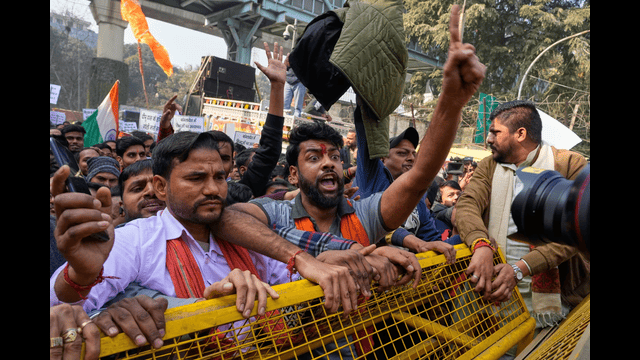
Activists of Vishwa Hindu Parishad, a prominent right-wing Hindu nationalist organization, shout slogans during a protest near Bangladesh High Commission accusing Bangladeshi groups of wrongly targeting Indians, in New Delhi, India, Tuesday, Dec.23, 2025
A protest broke out in India’s capital on Tuesday after the lynching of a Hindu man in Bangladesh.
The incident has deepened India-Bangladesh tensions and raised concerns over minority safety.
It also exposed fresh cracks in a relationship long seen as stable in South Asia.
Protest Near Bangladesh High Commission
Hundreds of demonstrators gathered near the Bangladesh High Commission in New Delhi.
The protest was led mainly by the Hindu nationalist group Vishva Hindu Parishad.
Participants shouted slogans and accused Bangladeshi groups of targeting religious minorities.
Placards carried strong messages.
Some read, “India will not tolerate torture of Hindus in Bangladesh.”
Others warned that silence should not be mistaken for weakness.
Heavy Security and Police Action
Authorities imposed tight security around the diplomatic enclave.
Barricades, armed police, and armored vehicles were deployed in large numbers.
Some protesters tried to break through security cordons.
Police used batons to stop them from entering the mission area.
No major injuries were reported during the clashes.
Lynching Sparks Outrage in India
The protest followed the killing of Dipu Chandra Das, a 25-year-old Hindu man.
He was lynched and burned publicly in Bangladesh’s Mymensingh district.
Local media said the attack followed allegations of blasphemy.
The killing triggered fear among Bangladesh’s Hindu community.
It also intensified anger across India, especially among Hindu groups.
Violence Follows Student Leader’s Death
Tensions had already risen after the death of Bangladeshi student leader Sharif Osman Hadi.
Hadi died in a Singapore hospital after being shot in Dhaka on December 12.
Bangladeshi police said suspects were identified and the shooter may have fled to India.
His death led to violent protests in Dhaka.
Two newspaper offices were torched during the unrest.
Indian diplomatic missions were also targeted by mobs.
Diplomatic Row Deepens
The violence pushed India-Bangladesh tensions into the diplomatic arena.
New Delhi summoned Bangladesh’s envoy earlier this week.
Bangladesh responded by summoning India’s high commissioner, Pranay Verma.
Dhaka raised concerns about the security of its missions in India.
These included offices in New Delhi, Kolkata, and Agartala.
Political Background Fuels Crisis
Hadi played a role in the 2024 uprising that ended Sheikh Hasina’s rule.
Hasina fled Bangladesh in August 2024 after 15 years in power.
She was considered a close ally of India during her tenure.
Hadi was a vocal critic of both Hasina and India.
He had planned to contest the February national elections as an independent candidate.
Minority Safety Under Scrutiny
Religious minority groups have blamed Bangladesh’s interim government for insecurity.
The interim administration is led by Nobel laureate Muhammad Yunus.
Hindus and Christians say protection has weakened since Hasina’s ouster.
The Yunus government has rejected these allegations.
It insists law enforcement is acting against perpetrators.
Experts Warn of Wider Impact
Analysts warn the protest could hurt regional cooperation.
Trade, border management, and connectivity may face new hurdles.
International affairs expert Sreeram Sundar Chaulia sees deeper risks.
He said anti-India rhetoric is pushing Bangladesh toward an exclusionary path.
Such moves could damage Bangladesh’s economy and regional standing.
Strategic Setback for Both Nations
The rupture is seen as a setback for India’s regional strategy.
Bangladesh could lose development aid and market access from India.
This may increase Dhaka’s reliance on China, experts warn.
Once a model partnership, India-Bangladesh relations now face uncertainty.
The latest protest shows how quickly stability can unravel in South Asia.