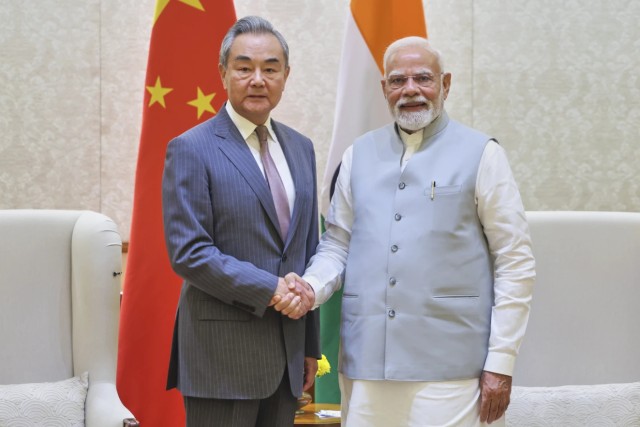
Indian Prime Minister Narendra Modi, right, shakes hand with Chinese Foreign Minister Wang Yi, left, in New Delhi, India, Tuesday, Aug.19, 2025.
Indian Prime Minister Narendra Modi met Chinese Foreign Minister Wang Yi on Tuesday, signaling a new chapter in India-China relations. The meeting comes after years of border tensions and strained ties between the two nuclear-armed Asian powers.
Modi described the talks as “steady progress” toward rebuilding trust. He stressed the need for “respect for each other’s interests and sensitivities.” China echoed a similar message, noting that ties have entered a “steady development track.”
Border Disputes Back in Focus
Wang Yi also held talks with India’s Foreign Minister S. Jaishankar and National Security Adviser Ajit Doval. Their discussions centered on border issues in the Himalayas. India’s Ministry of External Affairs confirmed that both sides explored “de-escalation, delimitation and boundary affairs.”
China’s Foreign Ministry added that both nations agreed to improve connectivity through direct flights, journalist visas, and business exchanges. Cultural cooperation will also be encouraged.
Healing After the 2020 Clash
Relations nosedived in 2020 when troops from both countries clashed in Ladakh. The violence killed 20 Indian and 4 Chinese soldiers, marking the deadliest border confrontation in decades. Since then, political dialogue and trade engagement were largely frozen.
“Setbacks in the past years were not in the interest of our people,” Wang said. He added that stability along the border has now been restored.
Modi reiterated India’s stand for peace, fairness, and a “mutually acceptable resolution” to the boundary dispute.
Trade, Travel, and Pilgrimage Revived
Signs of recovery have appeared over the past year. In 2023, both countries signed a pact on border patrols and withdrew extra troops from some regions. Talks have also resumed on trade movement through several border points.
China recently allowed Indian pilgrims to visit holy sites in Tibet. In June, the foreign ministries discussed easing restrictions on visas for business leaders and citizens.
Analysts note that while progress is visible, settlement of the dispute requires “political compromise at the highest level.”

Indian Foreign Minister S. Jaishankar shakes hands with his Chinese counterpart Wang Yi, left, in New Delhi, India, Monday, Aug. 18, 2025.
Modi’s Upcoming China Visit
Momentum for reconciliation began last October when Modi and President Xi Jinping met during a summit in Russia. It was their first in-person interaction since 2019.
Modi is expected to visit China later this month for the Shanghai Cooperation Organization (SCO) summit. This will be his first trip to China in seven years. The SCO, led by China and Russia, is seen as a counterbalance to U.S. influence in Asia.
Earlier this year, Xi urged India-China cooperation, calling it a “dragon-elephant tango” — symbolizing the dance between the two countries’ emblems.
U.S. Tariffs Push India Closer to China
The thaw in India-China relations coincides with tensions between New Delhi and Washington. U.S. President Donald Trump recently imposed steep tariffs on Indian goods, including penalties for buying Russian crude oil. The new tariffs, effective August 27, have sparked friction between the long-time partners.
India, however, has doubled down on ties with Russia, signing fresh economic agreements. Trump’s outreach to Pakistan has also nudged India toward Beijing. The U.S. president recently hosted Pakistan’s army chief, followed by an energy deal with Islamabad.
Pakistan, a key Chinese ally, used Chinese-made jets and missiles in its last clash with India. Experts argue that India cannot afford simultaneous hostilities with both China and Pakistan.
A Calculated Reset
For now, both India and China are exploring opportunities to rebuild trust without losing strategic ground. Direct flights, pilgrimages, and revived trade hint at warming ties. Yet, the border issue remains a sticking point that requires high-level political will.
As Modi prepares to meet Xi in China, the world watches closely. The outcome may define the next phase of India-China relations in Asia’s power balance.