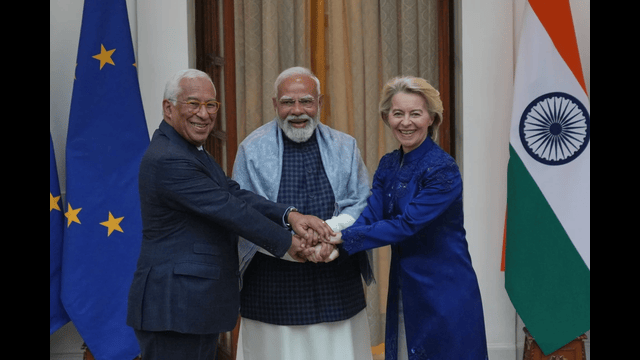
Indian Prime Minister Narendra Modi, cener welcomes European Council President Antonia Costa, left, and European Commission President Ursula Von der Leyen before their meeting in New Delhi, India, Tuesday, Jan 27, 2026.
India and the European Union have finalized a long-awaited free trade deal, marking a major shift in global commerce. Prime Minister Narendra Modi announced the agreement on Tuesday, calling it a breakthrough for economic and strategic cooperation. The deal ends nearly 20 years of negotiations and covers markets representing almost two billion people.
The agreement is being described by both sides as the “mother of all deals.” It arrives at a time of growing trade tensions worldwide and signals a clear push toward stronger partnerships outside the United States.
Modi said the free trade deal would unlock new opportunities for businesses and consumers across India and Europe. He highlighted its global impact while addressing an international energy conference virtually.
A Deal With Global Weight
The India-EU free trade deal brings together economies contributing 25 percent of global GDP. Together, they account for nearly one-third of global trade.
“This agreement will bring major opportunities for the people of India and Europe,” Modi said. He stressed its role in shaping a more stable global trading environment.
The timing is significant. Washington has imposed steep tariffs on both India and the EU, disrupting traditional trade routes. These pressures have pushed major economies to seek alternative alliances.
Trade Tensions Drive New Alliances
India has been hit with additional U.S. tariffs in recent months. These include a 25 percent levy on Indian goods over continued purchases of discounted Russian oil. Combined U.S. tariffs on Indian exports now stand at 50 percent.
As a result, New Delhi has accelerated efforts to diversify export destinations. The free trade deal with the EU is a central part of this strategy.
For Europe, the agreement offers access to one of the world’s fastest-growing major economies. It also helps European firms reduce dependence on volatile global markets.
Strengthening India-EU Economic Ties
Bilateral trade between India and the EU reached $136.5 billion in 2024-25. Officials on both sides aim to raise this figure to nearly $200 billion by 2030.
Indian trade officials said the free trade deal would ease market access and improve investment flows. Key sectors include manufacturing, technology, energy, and services.
Trade analyst Ajay Srivastava said the agreement goes beyond tariffs. He described it as an effort to build a stable commercial corridor between two major markets.
“Ultimately, the agreement is about stability at a time the global trading system is fragmenting,” he said.
Europe’s Push for Strategic Autonomy
The EU has been rethinking its global trade strategy amid strained relations with the United States. Many European leaders feel sidelined by Washington’s aggressive tariff policies and political stance.
U.S. President Donald Trump’s actions have fueled unease across the 27-nation bloc. His support for far-right parties and confrontational positions have deepened the rift.
In response, Brussels has expanded outreach to other regions. Over the past year, the EU has signed trade agreements with Japan, Indonesia, Mexico, and South American nations.
European Commission President Ursula von der Leyen has framed this approach as “strategic autonomy.” In practice, it reflects a gradual decoupling from an unpredictable U.S. partner.
A Message to a Fractured World
Von der Leyen arrived in India on Sunday ahead of the joint announcement with Modi. She said the India-EU free trade deal sends a strong global message.
“We are showing a fractured world that another way is possible,” she posted on X.
The agreement underscores a shared commitment to open markets and cooperation. For India and the EU, it marks the start of a new chapter in global trade.