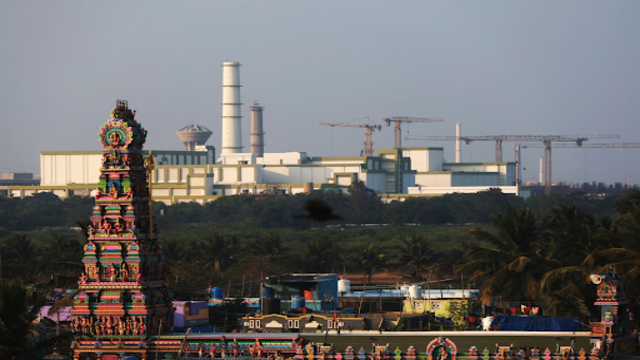
A temple stands in the foreground of the Madras Atomic Power Station, located in Kalpakkam. Associated Press
India has taken a major policy step by approving a bill that opens its civil nuclear power sector to private companies. The move marks a shift from decades of state control and signals India’s intent to accelerate clean energy growth. The legislation now awaits presidential assent, which is considered a formality.
India Parliament Pushes Nuclear Reform
Both houses of India’s Parliament cleared the bill this week. The lower house passed it on Wednesday. The upper house approved it on Thursday.
The government called the bill a landmark reform. It said the change will help meet rising energy demand and climate commitments. Opposition parties strongly disagreed. They warned about weakened safety and liability provisions.
Why the Civil Nuclear Power Bill Matters
The bill allows private firms to enter a sector long dominated by the state. Supporters say this could unlock investment, innovation, and faster project execution.
Globally, the move carries weight. Many countries are revisiting nuclear energy to cut emissions and reduce fossil fuel use. India wants to lead this next phase, including small modular reactors.
Government Sees Clean Energy Opportunity
Junior Minister Jitendra Singh, who oversees atomic energy, defended the bill in Parliament. He said it modernizes India’s nuclear framework.
According to Singh, the law aligns with current technological and economic realities. He stressed that core safety, security, and regulatory safeguards remain intact.
“India’s global role is expanding,” Singh told lawmakers. “We must meet global benchmarks and adopt global strategies.”
Ending State Monopoly in Nuclear Energy
Energy experts see the bill as a break from strict government control. Karthik Ganesan of the Council on Energy, Environment and Water called it a milestone.
He said the law signals serious intent to global and domestic investors. Private players now know India is open for nuclear business.
Supporters argue that without private capital, India’s nuclear goals will remain unreachable.
India’s Nuclear Ambitions Explained
India remains one of the world’s largest emitters of planet-heating gases. Over 75% of its electricity still comes from fossil fuels, mainly coal.
Nuclear power offers a low-carbon alternative. It produces electricity without greenhouse gas emissions, though it creates radioactive waste.
India aims to install 100 gigawatts of nuclear capacity by 2047. That amount could power nearly 60 million homes annually.
The government has pledged over $2 billion recently for nuclear research and related activities.
Experts Warn of Practical Challenges
Some energy analysts remain skeptical. India’s nuclear sector is still small compared to its ambitions. Public resistance also remains strong near plant sites.
Experts say nuclear power is needed because solar and wind are not always available. However, scaling safely and affordably remains a challenge.
Opposition Flags Safety and Liability Risks
Opposition parties demanded the bill be sent to a parliamentary panel. The government rejected that request.
Ashok Mittal of the Aam Aadmi Party raised health concerns. He warned about inadequate safeguards for communities near nuclear plants.
He said residents deserve stronger protection from potential radiation exposure.
Activists Call the Bill Dangerous
Anti-nuclear activist G. Sundarrajan sharply criticized the legislation. He described it as a “disastrous law.”
He argued that it weakens incentives for companies to invest in safety. He also warned about the risk of large-scale disasters.
Sundarrajan said the bill limits citizens’ ability to seek compensation. This applies even in cases of radiation leaks or long-term health damage.
What Comes Next for Nuclear Power
With presidential approval expected soon, the law is set to take effect. The focus will shift to implementation and regulation.
How India balances private participation with safety will define the sector’s future. For now, the civil nuclear power reform marks a bold and contested step in India’s energy journey.