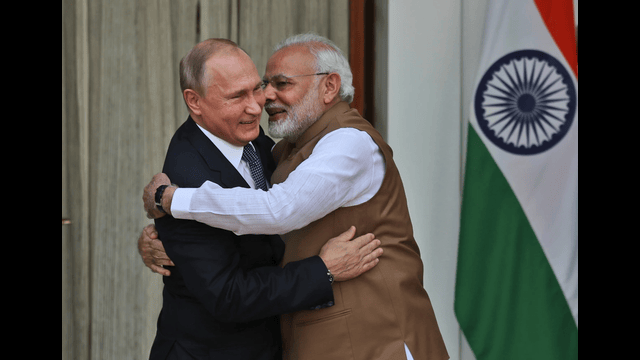
Indian Prime Minister Narendra Modi hugs Russian President Vladimir Putin before their meeting in New Delhi.
Russian President Vladimir Putin will arrive in India this week for a high-stakes summit that could redefine the trajectory of India–Russia relations amid global tensions. His meeting with Prime Minister Narendra Modi comes at a time when the war in Ukraine and U.S. pressure on New Delhi have created an extremely delicate diplomatic landscape.
Putin’s state visit begins Thursday, with formal talks scheduled for Friday. Both governments expect the leaders to review strategic cooperation, sign business agreements, and discuss issues tied to energy, defense, and long-term trade.
A Diplomatic Test for India
The Putin–Modi summit unfolds as India attempts to balance its deep ties with Russia and its growing partnership with the United States. Washington has repeatedly warned New Delhi against buying large volumes of discounted Russian oil, claiming the purchases indirectly support Moscow’s war effort.
The U.S. hardened its stance recently when President Donald Trump raised tariffs on Indian goods to 50%, intensifying pressure on India to curb Russian energy imports.
India has defended its position, arguing that affordable Russian oil is crucial for meeting the energy needs of its 1.4 billion citizens.
Putin last visited India in 2021, while Modi’s most recent Russia trip was in 2023. The two leaders also had a brief interaction at a Shanghai Cooperation Organization summit in China last year.
Peace Push and Strategic Balancing
The summit takes place as Washington pushes forward a revised Ukraine peace plan, which earlier drew criticism for appearing too favorable to Moscow.
Prime Minister Modi has avoided directly condemning Russia for the conflict, instead calling for dialogue and diplomacy.
International affairs expert Sreeram Sundar Chaulia says India has refrained from acting as a formal mediator because doing so could complicate relations with both Washington and Moscow. However, he noted that behind-the-scenes diplomatic efforts by Modi have already taken place.
According to Chaulia, Modi could encourage Putin to consider broader European and Ukrainian concerns in pursuit of peace.
Economic Cooperation to Dominate Talks
Economic cooperation will be the central theme of the Putin–Modi meeting. Officials expect a package of agreements covering trade, maritime cooperation, healthcare, media exchanges, and sector-specific collaborations.
India wants to boost exports of pharmaceuticals, agricultural products, fertilizers, and textiles to Russia while seeking the removal of several non-tariff barriers. New Delhi also aims to finalize a framework for the safe migration of skilled Indian workers to Russia.
Energy security—particularly oil and nuclear cooperation—will be a major discussion area.
U.S. Pressure Over Russian Oil Imports
The U.S. remains uncomfortable with India’s continued purchase of discounted Russian crude. With new sanctions hitting oil giants Rosneft and Lukoil, India has stated it will not buy crude from sanctioned companies but will continue procuring oil from non-restricted Russian suppliers.
Foreign policy analyst Harsh Pant says India will emphasize that it has no intention of completely halting Russian oil imports. He added that future volumes will depend on market conditions and how sanctions affect Indian state and private refiners.
The summit will also touch on India’s nuclear energy partnership with Russia, particularly ongoing work at the Kudankulam nuclear plant in Tamil Nadu.
Defense Cooperation Remains Core Pillar
India will push for faster delivery of the remaining S-400 missile system units under the 2018 agreement. Delivery delays have been attributed to supply chain disruptions caused by the Ukraine conflict.
Defense Secretary Rajesh Kumar Singh confirmed that broader defense cooperation will dominate the agenda, including possible upgrades to India’s Su-30MKI aircraft, discussions on joint exercises, and accelerated delivery of key military platforms.
Russia remains India’s largest defense supplier, though New Delhi has diversified purchases in recent years. Moscow is eager to sell its Su-57 stealth fighter, but India continues evaluating multiple options.