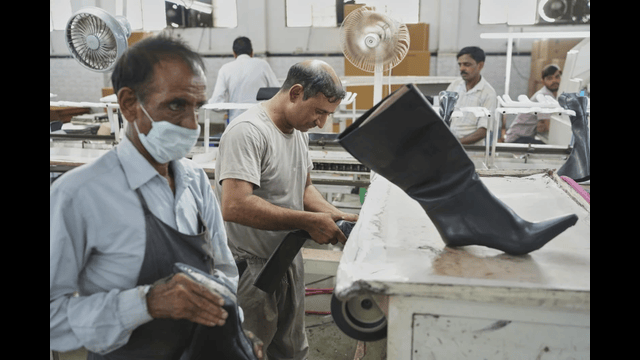
Workers in a manufacturing unit make leather footwear in Agra, India, Monday, Aug. 25, 2025.
India is preparing for a major blow to its export market after steep US tariffs took effect on Wednesday. The move threatens more than half of India’s shipments to its largest trading partner and highlights the fragile state of India–US trade ties.
Earlier, President Donald Trump had announced a 25% tariff on Indian products. But this month, he signed an executive order imposing an additional 25% duty, citing India’s continued purchase of Russian oil. With combined tariffs now at 50%, India estimates $48.2 billion worth of exports will be impacted.
Officials fear these tariffs could make trade with the US unviable. That may result in large job losses, weaker growth, and pressure on export-driven industries.
Which Indian Sectors Will Be Affected Most?
The Global Trade Research Initiative, a New Delhi-based think tank, predicts labor-intensive industries will suffer the hardest hit. These include textiles, gems and jewelry, leather goods, food products, and automobiles.
Ajay Srivastava, founder of the initiative and former trade official, warned that the tariffs could dismantle India’s strong presence in the US market. “This is a strategic shock,” he said, adding that the move could fuel unemployment and disrupt India’s role in global supply chains.
Pharmaceuticals and electronic goods, however, remain exempt from the new tariffs, offering some relief to India since these are major export sectors.
Exporters Sound Alarm Over Heavy Losses
Many exporters fear an immediate decline in trade. Leather footwear exporter Puran Dawar, based in Agra, said the tariffs could cripple businesses unless local demand strengthens and other global buyers step in.
“This is an absolute shock,” said Dawar, whose US business has grown steadily in recent years. His clients include leading brands like Zara.
Dawar, also the regional chairman of the Council for Leather Exports, believes US consumers will ultimately pay the price for higher duties.
Industry groups share this concern. Small and medium enterprises, which depend heavily on American buyers, are especially vulnerable. Ajay Sahai, director general of the Federation of Indian Export Organisations, warned that “some product lines will simply become unviable overnight.”
Modi Rejects US Pressure Amid Trade Standoff
The tariff escalation comes as Washington pushes for more access to India’s agriculture and dairy sectors. Five rounds of trade talks between the two nations have failed, largely due to India’s resistance to opening sensitive markets to cheaper US imports.
Prime Minister Narendra Modi has vowed not to bow to American pressure. Addressing a rally in Gujarat, he stressed that farmers, small businesses, and dairy workers would not be compromised. “The world is witnessing a politics of economic selfishness,” Modi declared.
Meanwhile, a planned sixth round of trade negotiations was cancelled after a US delegation called off its visit to New Delhi.
India Plans Reforms to Cushion Tariff Impact
The Indian government has begun preparing measures to protect the economy and soften the blow from tariffs. Officials are considering tax cuts on cars, appliances, and insurance under the Goods and Services Tax ahead of Diwali, a peak consumption season.
Financial incentives such as cheaper export loans are also under discussion. At the same time, the government is exploring ways to expand trade in Latin America, Africa, and Southeast Asia.
Negotiations with the European Union may also gain urgency as India looks to reduce its reliance on the American market.