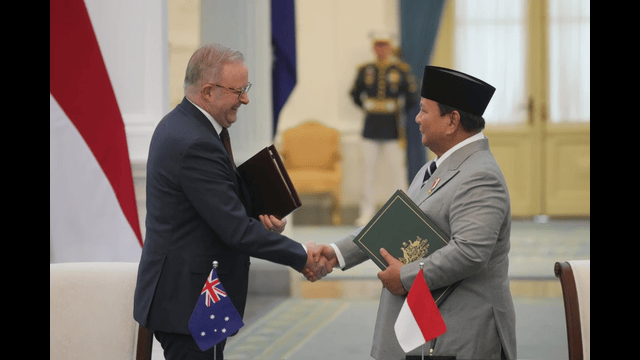
Australian Prime Minister Antony Albanese, left, shakes hands with Indonesian Prabowo Subianto at the end of a documenting signing ceremony.
Indonesia and Australia have taken a major step to strengthen bilateral ties.
Both nations signed a new security treaty in Jakarta on Friday.
Leaders described the pact as a milestone in their evolving partnership.
The agreement aims to deepen cooperation between the neighboring countries.
The signing comes amid shifting regional dynamics in the Indo-Pacific.
It also reflects renewed political will on both sides.
Officials say the treaty builds on decades of past security engagement.
From Talks to Treaty
The Indonesia-Australia security treaty follows months of negotiations.
Australian Prime Minister Anthony Albanese and Indonesian President Prabowo Subianto announced progress in Sydney earlier.
They confirmed talks were largely finalized three months ago.
The pact is designed to strengthen earlier agreements signed in 1995 and 2006.
Those frameworks laid foundations for security dialogue and cooperation.
Leaders now want to modernize and expand those commitments.
Leaders Emphasize Trust
Speaking in Jakarta, Albanese praised the treaty’s significance.
He called it an extension of long-standing defense cooperation.
According to him, it reflects unmatched trust between both nations.
Albanese said the relationship is stronger than ever before.
He stressed that shared values support deeper collaboration.
The treaty text has not yet been made public.
A Strategic Partnership
President Prabowo highlighted Australia’s importance to Indonesia.
He described Australia as a close neighbor and strategic partner.
Prabowo said the treaty shows shared responsibility for regional stability.
He emphasized cooperation to protect national security interests.
Prabowo also linked the pact to peace across the Indo-Pacific.
He said both countries choose trust over tension.
Beyond Defense Cooperation
Albanese arrived in Jakarta late Thursday for a three-day state visit.
It marked his fifth official trip to Indonesia.
His office said the visit aims to broaden cooperation.
The focus goes beyond security.
It includes trade, education, investment, and development initiatives.
Foreign Minister Penny Wong joined the delegation.
Wong described the treaty as historic.
She said it was the most important step in three decades.
The government sees it as a long-term investment in regional ties.
New Security Initiatives Announced
Albanese outlined fresh security measures during the visit.
Australia will embed a senior Indonesian officer in its defense force.
Both countries will support joint defense training facilities.
Military education exchanges will also expand.
Leaders believe closer defense integration improves mutual understanding.
They stressed collaboration as the key to regional peace.
Regional Context and China Factor
Analysts say the Indonesia Australia security treaty holds growing importance.
Australia faces rising strategic competition in the region.
China’s expanding influence adds urgency to stronger partnerships.
Experts note the treaty may resemble earlier agreements.
The 1995 pact required consultation on security threats.
Indonesia withdrew from it after the East Timor crisis.
Security ties were later restored through the 2006 Lombok Treaty.
That agreement was expanded again in 2014.
The new treaty builds on that gradual rebuilding process.
A Symbolic but Meaningful Pact
Policy experts describe the treaty as largely symbolic.
Susannah Patton from the Lowy Institute shared this view.
She said it focuses on political commitment, not binding defense obligations.
The agreement sits below Australia’s U.S. alliance.
It also ranks under its security deal with Papua New Guinea.
Indonesia remains a non-aligned nation.
Patton said a mutual defense pact would be unacceptable to Jakarta.
However, she praised the treaty’s political significance.
She called it a major success for Albanese.
A Relationship Tested Before
Indonesia and Australia share a complex history.
The relationship has faced repeated diplomatic strains.
Past disputes included intelligence spying allegations.
Other tensions involved drug trafficking cases.
People smuggling issues also caused friction.
Despite challenges, cooperation has endured.
The new Indonesia Australia security treaty signals renewed confidence.
Both leaders see it as a pillar for regional stability.
For now, it marks a clear step toward closer strategic alignment.