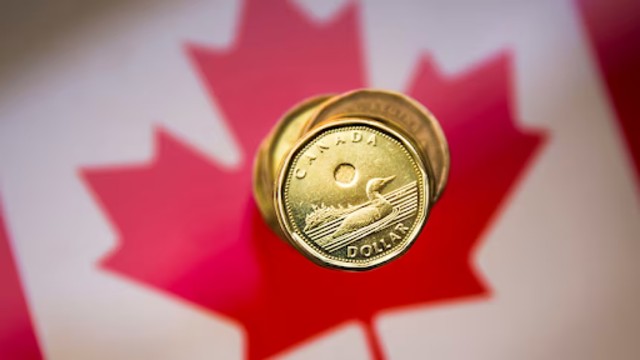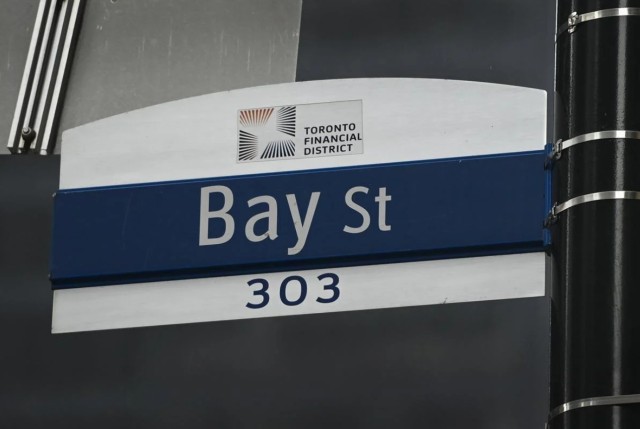
A street sign is seen on Bay Street in Toronto’s financial district (Photo credit: Nathan Denette, The Canadian Press)
Stock markets in both Canada and the United States took a dip Friday following reports of Israeli military strikes on Iran’s nuclear and defence facilities. The attacks led Iran to retaliate by firing missiles at Israel, sparking fears of a larger conflict in the region.
The escalating situation drove investors to pull back, causing a broad sell-off in the markets. Canada’s main stock index, the S&P/TSX composite, fell 111.40 points to close at 26,504.35. U.S. markets saw even sharper declines.
The Dow Jones Industrial Average dropped 769.83 points, or 1.8%, closing at 42,197.79. Meanwhile, the S&P 500 slipped 68.29 points to 5,976.97, and the Nasdaq tumbled 255.66 points to finish at 19,406.83.
One of the biggest ripples from the conflict was the sudden jump in oil prices. As fears of trade interruptions and reduced oil supply took hold, the August crude oil contract surged by $4.65 to reach $71.29 per barrel. This spike in oil prices helped cushion some of the losses for energy-heavy indices like Canada’s TSX.
“Investors are clearly pulling back. This is the kind of scenario where people reduce their exposure to risk,” explained Dustin Reid, chief fixed income strategist at Mackenzie Investments.
Sectors tied to commodities showed some resilience. The TSX energy index climbed 2.8%, and gold-related stocks also moved higher as the precious metal gained value. These gains helped offset losses in other key areas like finance, telecommunications, and technology.
The upward trend in oil has raised fresh concerns about inflation. Rising energy costs could slow consumer spending and put pressure on central banks to delay any plans to lower interest rates, said Reid.
“This doesn’t help the idea that rate cuts are coming soon,” he noted. “And it’s definitely not helpful for consumer confidence or the global mood.”
In currency markets, the Canadian dollar edged up slightly to 73.54 cents US from 73.46 cents on Thursday. The rise was driven by stronger oil prices, but the loonie didn’t climb much as investors turned to the U.S. dollar, a traditional safe-haven in times of uncertainty.
“The Canadian dollar held up but didn’t rally the way it might have,” said Reid. “A lot of money is flowing into the U.S. dollar because of the geopolitical risk.”
Adding to the economic worries, Canada’s manufacturing sector showed signs of weakness. April’s sales fell 2.8%, the biggest decline since October last year. Ongoing trade tensions with the U.S. have taken a toll on factories and overall industrial activity.
“The Canadian economy is slowing, and this trend looks like it will continue,” Reid added. “Manufacturing is just one part of the picture.”
Meanwhile, other commodities also moved. Natural gas prices for July went up by nine cents to US$3.58 per mmBTU. Gold surged by US$50.40 to US$3,452.80 an ounce, while copper dipped three cents to US$4.81 a pound.