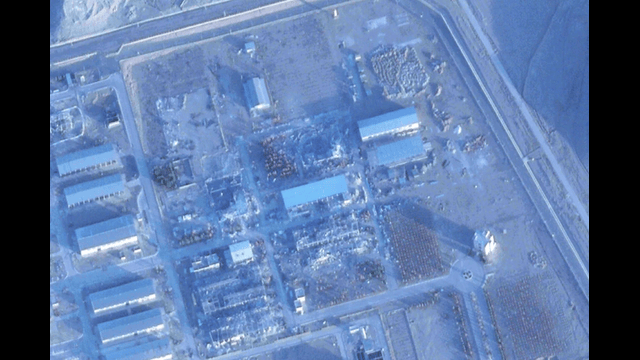
This satellite image from Planet Labs PBC shows a roof built over rubble at Iran’s Isfahan Nuclear Technology Center outside of Isfahan, Iran, on Wednesday, Jan. 28, 2026
Satellite images have revealed fresh activity at key Iran nuclear sites.
The developments come as tensions rise over Tehran’s violent crackdown on protests.
The images suggest Iran may be trying to conceal sensitive work from global scrutiny.
Recent photos captured by Planet Labs PBC show new roofs at damaged facilities.
The structures cover buildings at Isfahan and Natanz.
Both sites were bombed last year by Israel and the United States.
The coverings limit satellite visibility from space.
They also block the only monitoring option currently available.
Iran has denied access to inspectors from the International Atomic Energy Agency.
Silence From Tehran and Global Watchdogs
Iran has not publicly explained the construction activity.
The IAEA also declined to comment on the images.
Inspectors have been barred from the sites since last year’s strikes.
Analysts believe the work is not simple reconstruction.
Instead, it may aim to hide recovery efforts.
Iran could be searching for surviving nuclear materials.
Pressure Mounts From Washington
U.S. President Donald Trump has increased pressure on Tehran.
He has demanded renewed negotiations over Iran’s nuclear program.
He has also warned of possible American military action.
The United States has reinforced its military presence in the Middle East.
The USS Abraham Lincoln and guided-missile destroyers have been deployed.
However, no final decision on strikes has been announced.
Experts Weigh In on the New Roofs
Nuclear experts say the roofs likely serve one purpose.
They obscure ground-level activity from satellites.
This limits external assessment of potential asset recovery.
Analysts believe Iran may be checking whether enriched uranium survived.
Such materials would be strategically valuable.
Their recovery would be closely guarded.
Why Isfahan and Natanz Matter
Before last year’s war, Iran operated three major nuclear sites.
Natanz and Isfahan were central to its program.
Iran has long claimed its efforts were peaceful.
Western governments remain skeptical.
The IAEA says Iran had a weapons program until 2003.
Officials warn nuclear ambitions may be reviving.
Natanz, south of Tehran, handled most uranium enrichment.
It housed advanced centrifuges and underground halls.
Before the attack, enrichment reached 60 percent purity.
Isfahan played a different role.
It produced uranium gas used in enrichment.
The site was vital to Iran’s nuclear supply chain.
Damage From Last Year’s Strikes
Israel launched the first attacks during a 12-day conflict.
The United States followed with bunker-busting bombs and cruise missiles.
Washington said the strikes severely degraded Iran’s nuclear capacity.
At Natanz, above-ground facilities were destroyed.
Underground centrifuge halls were heavily damaged.
Electric systems appear nonfunctional even today.
New Construction Raises Questions
Satellite images show roof construction began in December.
Work at Natanz finished by month’s end.
Similar activity appeared at Isfahan in early January.
Iran has also continued excavation near Natanz.
The digging site lies south of the facility perimeter.
Experts believe a new underground complex is underway.
Tunnel Activity Fuels More Concern
Near Isfahan, two tunnels have been filled with dirt.
This tactic protects against missile strikes.
A third tunnel appears newly reinforced.
New walls and cleared entrances suggest added security.
The moves mirror steps taken before previous conflicts.
They hint at heightened defensive planning.
Broader Military Rebuilding Continues
Iran is also rebuilding its ballistic missile infrastructure.
Work has resumed at the Parchin military complex.
The site has a history linked to weapons research.
At Parchin’s “Taleghan 2” facility, construction has accelerated.
Israel destroyed the site in October 2024.
It was linked to explosive testing research.
Satellite photos show rapid expansion.
Analysts say the facility may resist future airstrikes.
Large containment vessels suggest high-explosive testing capability.
Growing Uncertainty Ahead
Satellite photos of Iran nuclear sites have raised global alarm.
The lack of transparency deepens international concern.
Diplomatic and military tensions continue to build.
What Iran plans next remains unclear.
What is certain is that scrutiny will only intensify.