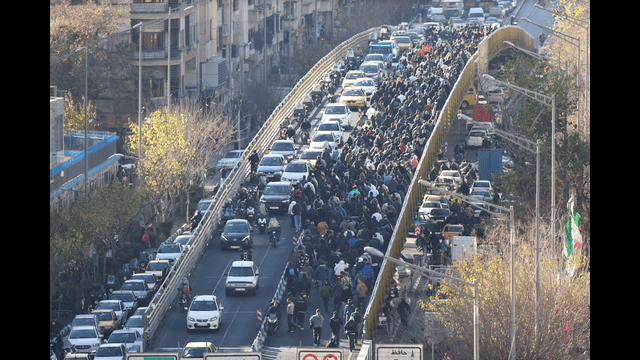
Protesters march down in Tehran, Iran, Monday, Dec 29, 2025.
Public anger is rising in Iran as the national currency hits historic lows.
Economic anxiety is spilling onto the streets, especially in the capital.
On Sunday, protests broke out in central Tehran.
Demonstrations were reported in two major mobile phone markets downtown.
Crowds chanted anti-government slogans and voiced economic frustration.
Security forces were present, but protests remained localized.
Iran Rial Plunge Triggers Public Outcry
The Iranian rial plunged sharply over the weekend.
On Sunday, it hit a record 1.42 million rials to the US dollar.
By Monday, it slightly recovered to 1.38 million per dollar.
The rebound did little to calm public concern.
The rapid fall has shaken confidence in Iran’s economy.
Many traders fear further depreciation in the coming weeks.
Ordinary citizens are already feeling the pressure.
Inflation Bites as Prices Surge Nationwide
The Iran rial plunge is worsening inflationary stress.
Prices of essential goods are rising at an alarming pace.
Food, medicine, and transport costs have jumped significantly.
According to Iran’s state statistics center, inflation reached 42.2 percent in December.
That figure is 1.8 percent higher than in November.
Food prices rose 72 percent compared to last year.
Health and medical items surged nearly 50 percent.
Critics warn Iran may be nearing hyperinflation.
Household budgets are shrinking rapidly.
Many families are cutting back on basic necessities.
Fuel Changes Add to Economic Anxiety
Recent changes to gasoline pricing have fueled more concern.
Higher fuel costs often ripple across the economy.
Transport and food prices typically rise soon after.
Economists warn the Iran rial plunge could intensify this effect.
Lower currency value makes imports more expensive.
That cost is passed directly to consumers.
Leadership Pressure Grows Inside Iran
The economic turmoil is also creating political strain.
Reports suggest central bank chief Mohammad Reza Farzin may resign.
Speculation about his departure has circulated for over a week.
When Farzin assumed office in 2022, the rial traded near 430,000 per dollar.
Since then, its value has collapsed dramatically.
Critics blame policy failures and weak currency controls.
Tax Hike Reports Stir Fresh Fears
Further anxiety followed reports of possible tax increases.
State media suggested higher taxes may begin in March.
The Iranian new year starts on March 21.
Business owners fear reduced consumer spending.
Workers worry about shrinking take-home incomes.
The Iran rial plunge has already reduced purchasing power.
Sanctions Legacy Still Weighs Heavy
Iran’s currency struggles are closely tied to sanctions.
In 2015, the rial traded near 32,000 per dollar.
That was after the nuclear deal eased international restrictions.
The agreement collapsed in 2018.
Former US President Donald Trump withdrew from the deal.
Sanctions were reimposed and intensified.
Since then, Iran’s economy has faced isolation.
Foreign investment dried up.
Access to global markets became limited.
Renewed Sanctions and Regional Tensions
In September, the United Nations reinstated nuclear-related sanctions.
Diplomats called it a “snapback” mechanism.
Iranian assets abroad were frozen again.
Arms transactions were halted.
Penalties linked to Iran’s missile program returned.
These measures deepened economic uncertainty.
Meanwhile, regional tensions are rising.
June’s 12-day war involving Iran and Israel rattled markets.
Many fear a broader conflict could emerge.
There is also concern about possible US involvement.
Such fears are adding pressure on the rial.
Market confidence remains fragile.
A Nation on Economic Edge
The Iran rial plunge has become a symbol of deeper issues.
Inflation, sanctions, and uncertainty are converging.
Public patience appears to be wearing thin.
While protests remain limited for now, frustration is widespread.
Many Iranians fear tougher days lie ahead.
Economic stability remains uncertain as pressures continue to mount.