Priests and officials in the Shinto priesthood march during Yamaguchisai, a kickoff ceremony of the Shikinen Sengu ritual, which concludes in 2033, at Kotaijingu, also known as Naiku, or the inner sanctuary, of the Jingu shrine complex in Ise, central Japan, Friday, May 2, 2025.
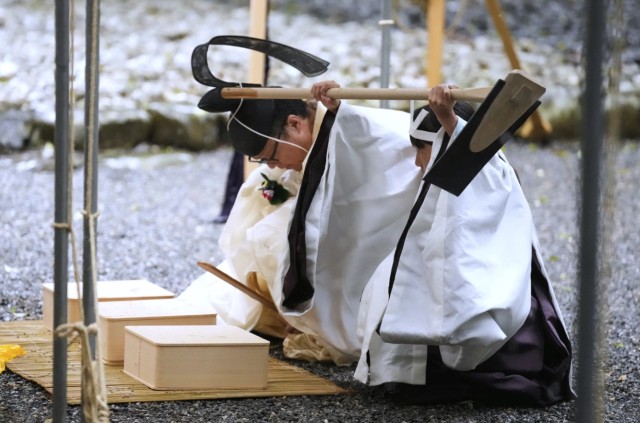
Deep within the Japanese Alps, an ancient ritual continues. Woodsmen in ceremonial white strike their axes in perfect rhythm. Two towering cypress trees, more than 300 years old, crash to the ground with thunderous echoes.
This scene is not random logging. It is part of a sacred rebuilding process at Ise Jingu shrine, Japan’s most revered Shinto site. For over 1,300 years, the shrine has been torn down and rebuilt every 20 years, in an extraordinary cycle of faith, craftsmanship, and renewal.
Rebuilding Japan’s Most Sacred Shrine
The Ise Jingu shrine is dismantled and reconstructed from scratch in each cycle. The project takes nine years and costs nearly $390 million. Around 125 buildings, along with ritual garments and objects, are recreated with precision.
This is the 63rd cycle, first recorded in 690 during Empress Jitō’s reign. Each reconstruction involves Japan’s finest carpenters, artisans, and priests, who dedicate their skills to preserving tradition.
A Shrine That Lives, Dies, and Lives Again
The buildings stand only about a decade before preparations begin again. Yet, each cycle is celebrated with joy. Workers cry out: “A building for a thousand years! Ten thousand years! Forever!”
Priests and locals see the rebuilding not as destruction, but renewal. As Shinto priest Yosuke Kawanishi explains, “After 20 years, the shrine is old. We want the deity to move into a beautiful, fresh place.”
The Nine-Year Ritual of Renewal
The shrine’s inner sanctuary honors Amaterasu, the sun goddess. She has been worshipped here for nearly 2,000 years, on the banks of the Isuzu River in Mie Prefecture.
The rebuilding includes 33 ceremonies. The final event, scheduled for 2033, transfers the deity into the new shrine. Visitors often describe the atmosphere as mysterious and moving.
Why Rebuild Every 20 Years?
Historians and scholars suggest many reasons. Some believe the 20-year cycle mirrors the shelf-life of stored rice. Others link it to human lifespans: youth, adulthood, and middle age.
Photographer Miori Inata, who documented the rebuilding for a decade, described the ceremonies as deeply emotional. “It was the same ritual performed 1,300 years ago, repeated endlessly into the future,” she wrote.
Interruptions Only in Times of Crisis
In 1,300 years, the rebuilding of Ise Jingu shrine stopped only twice: during civil wars in the 15th and 16th centuries, and again after World War II. Many shrines once followed similar cycles, but only Ise has preserved the tradition so faithfully.
Seeking Permission from the Mountains
Before cutting sacred cypress, priests perform rituals to ask permission from mountain deities. They emphasize respect for nature, a central belief in Shinto.
At one ceremony, thousands gathered despite heavy rain. Priests marched in starched robes, drums thundered, and prayers filled the air. The spiritual connection between people, nature, and kami—the divine spirits—was palpable.
A Rare and Precious Experience
More than seven million pilgrims visit the Ise Jingu shrine each year. Many describe it as life-changing.
Visitor Yuto Nakase said, “You can count on one hand how many times you’ll witness this. It’s rare and precious.”
Locals also feel the shrine’s unique aura. “My breathing changes when I enter,” said sake shop owner Yoriko Maeda. “The wind, the sounds—everything feels different. It releases my stress.”
Honoring the Trees That Give Life
The cypress used for rebuilding is treated with deep reverence. After a tree falls, woodcutters insert its tip into another stump, symbolizing continuity of life.
Wood expert Soju Ikeda calls it “a prayer for regeneration of the forest.” For him, the relationship with these trees is “deep.”
He recalls watching a tree fall as a young man. “When the axe struck the core, the scent of cypress flowed like blood. The sound was like a shriek. In that moment, I felt the tree cried.”
An Enduring Cycle of Faith and Craft
From the harvesting of cypress to the final consecration, the Ise Jingu shrine rebuilding is a sacred journey. It blends faith, tradition, and reverence for nature into a timeless cycle.
What began in the 7th century continues today, promising to endure for generations yet to come.