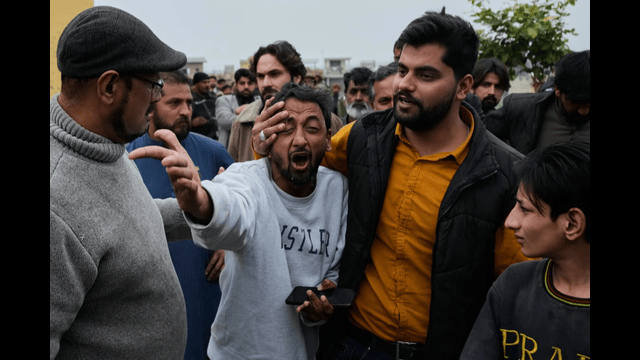
People comfort a man, center, mourning over the death of his relative, close to the site of a bomb explosion at a Shiite mosque, in Islamabad, Pakistan, Friday, Feb. 6, 2026.
A devastating suicide bombing struck a Shiite mosque on Islamabad’s outskirts during Friday prayers.
At least 31 worshippers were killed.
More than 169 people were wounded, officials confirmed.
The rare Islamabad suicide bombing has shaken Pakistan’s capital.
The blast hit the Khadija Al-Kubra mosque, a large and crowded place of worship.
It occurred as worshippers gathered for weekly prayers.
Many victims were trapped inside the mosque.
Chaos After the Blast
Television footage showed scenes of panic and destruction.
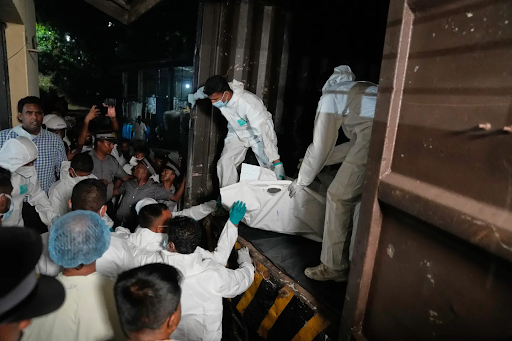
Police officers and residents rushed victims to nearby hospitals.
Several injured worshippers remain in critical condition.
Rescue workers described a horrific scene inside the mosque.
Bodies and injured people lay scattered across the carpeted floor.
Blood-stained prayer mats added to the devastation.
Eyewitnesses Recall Horror
Hussain Shah was praying in the courtyard when the explosion struck.
He said the blast was sudden and extremely loud.
“At that moment, I knew something terrible had happened,” he said.
Shah entered the mosque moments later.
He found chaos, screaming, and injured worshippers crying for help.
He counted around 30 bodies inside the mosque.
Responsibility Still Unclear
No group immediately claimed responsibility for the Islamabad suicide bombing.
Suspicion has fallen on militant groups operating in Pakistan.
These include the Pakistani Taliban and the Islamic State affiliate.
Both groups have targeted Shiite minorities in the past.
Shiites form a small but significant community in Pakistan.
They have faced repeated sectarian attacks over the years.
Militancy Rising Across Pakistan
Although Islamabad is rarely targeted, violence has surged nationwide.
Recent attacks are largely blamed on the Pakistani Taliban and Baloch separatists.
Islamic State-linked groups have also increased activity.
Islamabad Deputy Commissioner Irfan Memon confirmed the updated casualty figures.
Earlier reports had listed fewer deaths and injuries.
The toll rose as rescue operations continued.
Claims of Cross-Border Links
Defense Minister Khawaja Mohammad Asif addressed the attack on social media.
He said early findings suggested the bomber had traveled to and from Afghanistan.
According to Asif, mosque guards tried to stop the attacker.
The suspect reportedly opened fire on the guards.
He then detonated explosives among worshippers.
The condition of the guards remains unknown.
Afghanistan Rejects Allegations
Afghanistan strongly condemned the Islamabad suicide bombing.
Its Defense Ministry rejected any link to the attack.
Officials called Pakistan’s claims irresponsible.
Pakistan has often accused Afghanistan of sheltering militants.
These accusations increased after the Taliban returned to power in 2021.
Kabul has repeatedly denied harboring Pakistani militants.
Afghanistan’s Foreign Ministry condemned the mosque attack.
It said violence against worshippers violates sacred values.
It also expressed sympathy for the victims.
Leaders and World React
Pakistan’s leadership swiftly condemned the attack.
President Asif Ali Zardari called it a crime against humanity.
He promised full support for the victims’ families.
Prime Minister Shehbaz Sharif demanded swift justice.
He ordered authorities to provide all medical assistance.
Interior Minister Mohsin Naqvi also denounced the bombing.
International condemnation followed soon after.
The United States and European Union issued statements.
Several foreign embassies in Islamabad expressed condolences.
Security Concerns Intensify
The attack occurred during a high-profile diplomatic visit.
Uzbekistan’s president was attending events in Islamabad.
The venue was several miles from the blast site.
Shiite leader Raja Nasir criticized security failures.
He questioned the effectiveness of law enforcement in the capital.
He urged citizens to donate blood urgently.
A Grim Reminder for the Capital
This was Islamabad’s deadliest attack since 2008.
That year, a suicide bomber struck the Marriott Hotel.
Sixty-three people were killed in that attack.
The latest violence followed deadly attacks in Balochistan last week.
Security forces claimed to have killed hundreds of militants afterward.
Fear and uncertainty now grip the capital again.
In response, Punjab’s chief minister canceled public events.
Festive celebrations were scaled back across major cities.
The Islamabad suicide bombing has left the nation in mourning.