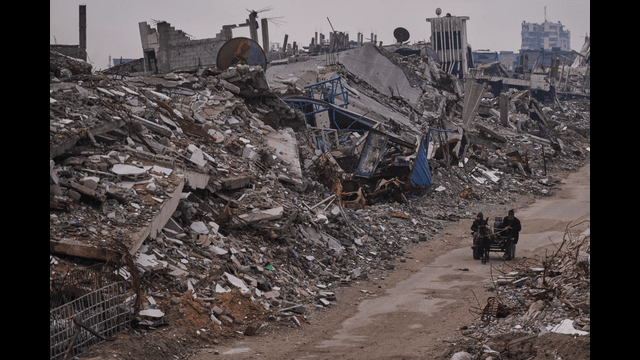
Palestinians pass along a street surrounded by buildings destroyed during Israel's air and ground operations in the Sheikh Radian neighborhood in Gaza City.
Israel has announced a major shift affecting humanitarian organizations in Gaza.
The decision could reshape how aid reaches civilians in the war-torn territory.
Israel said it will halt the operations of several humanitarian organizations in Gaza starting in 2026.
More than two dozen groups have been suspended for failing to meet new registration rules.
The move has drawn strong criticism from aid agencies.
They warn it will deepen suffering among Gaza’s civilian population.
Israel humanitarian organizations Gaza under new regulations
Israeli authorities said the rules aim to prevent militant infiltration.
Officials argue Hamas and other armed groups have exploited humanitarian channels.
The regulations were announced earlier this year.
They require organizations to register staff names and disclose funding details.
Aid groups must also provide operational information.
Failure to comply leads to suspension or license revocation.
Israel claims these steps are essential for national security.
Humanitarian organizations dispute that justification.
Ideological conditions raise alarm
The new framework includes ideological requirements.
Organizations are disqualified if they criticized Israel in specific ways.
This includes support for boycotts against Israel.
It also covers denial of the October 7 attack.
Groups backing international court cases against Israeli leaders also face disqualification.
Aid agencies say these conditions undermine neutrality.
They argue humanitarian work should remain separate from politics.
Many see the rules as arbitrary and punitive.
Scale of suspensions explained
Israel’s Ministry of Diaspora Affairs said over 30 groups failed to comply.
That represents about 15% of organizations operating in Gaza.
Among them is Doctors Without Borders, known as MSF.
It is one of the largest medical providers in the enclave.
The ministry said MSF did not respond to claims about staff affiliations.
It alleged links to Hamas or Islamic Jihad.
Diaspora Affairs Minister Amichai Chikli defended the move.
He said aid is welcome, but terrorism exploitation is not.
Doctors Without Borders warns of severe impact
Doctors Without Borders rejected Israel’s accusations.
The organization called the decision catastrophic.
MSF supports around 20% of Gaza’s hospital beds.
It also assists in one-third of all births.
“MSF would never knowingly employ fighters,” the group said.
It stressed strict screening and humanitarian principles.
The organization warned medical services could collapse.
Patients and pregnant women would face grave risks.
Exhausted local staff and safety fears
Other aid groups echoed similar concerns.
They said the timing is devastating.
The suspensions come during a fragile ceasefire.
Needs remain overwhelming across Gaza.
Shaina Low from the Norwegian Refugee Council spoke out.
Her organization is also suspended.
She said international staff are blocked from entering Gaza.
This leaves already exhausted local workers overwhelmed.
Some groups refused to submit Palestinian staff lists.
They cited safety risks and European data protection laws.
Aid workers have been repeatedly killed during the conflict.
Organizations fear staff could be targeted.
What the suspension means on the ground
Licenses for affected groups will expire on January 1.
Offices in Israel and East Jerusalem must close.
Organizations based in Israel must leave by March 1.
Appeals are permitted under the process.
Israel’s aid coordination body, COGAT, downplayed the impact.
It said these groups provide less than 1% of Gaza’s aid.
COGAT added that over 20 approved organizations will continue work.
It insisted aid flows will not stop.
Broader crackdown and UNRWA precedent
This is not Israel’s first clash with aid agencies.
Throughout the war, Israel accused UNRWA of Hamas infiltration.
The United Nations denied those claims.
UNRWA said it removes any suspected militants quickly.
Israel banned UNRWA from operating on its territory in January.
The United States also halted funding in early 2024.
Aid groups see a troubling pattern emerging.
They fear shrinking humanitarian space.
NGOs demand clarity on data use
NGOs say Israel remains vague about staff data use.
They worry information could serve military or intelligence purposes.
Athena Rayburn of AIDA voiced strong objections.
Her group represents over 100 organizations.
She said vetting staff by a conflict party violates neutrality.
More than 500 aid workers have been killed so far.
Rayburn said groups proposed third-party vetting alternatives.
Israel allegedly refused dialogue.
Gaza civilian toll continues to rise
Violence in Gaza continues alongside aid disputes.
A 10-year-old girl was killed in Gaza City on Tuesday.
Another person was wounded near the Yellow Line.
The Israeli military did not immediately comment.
Gaza’s Health Ministry reported over 71,000 Palestinian deaths.
The figure excludes the latest child casualty.
While Israel disputes the numbers, it has not released its own.
International experts consider the ministry’s data broadly reliable.