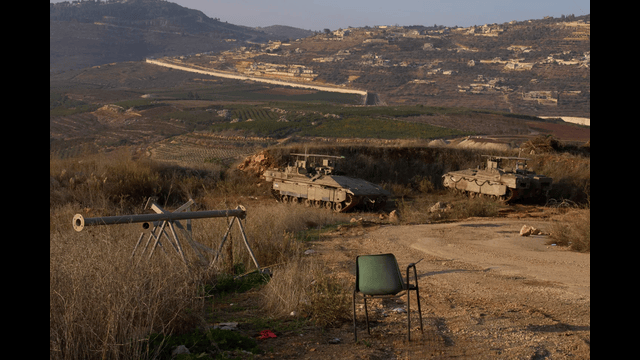
Israel’s military armored personnel carriers sit in Israel’s northernmost town of Metula, on the Lebanon border, Sunday, Nov. 30, 2025.
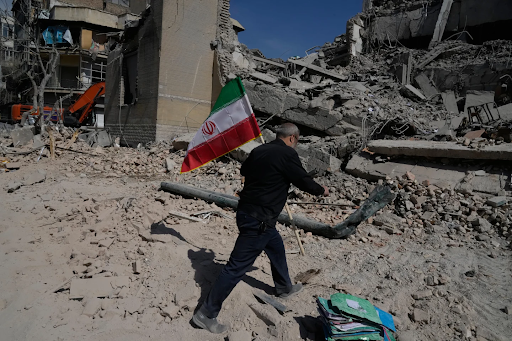
The cracks of shattered clay and burned metal echo under Ilan Rosenfeld’s feet as he walks through the ruins of his old café in Metula, the northernmost town in Israel. His business, destroyed by Hezbollah rockets, now stands as a grim reminder of a conflict that has scarred this border community.
“Everything I built is gone,” Rosenfeld says, standing amid scorched debris. “Every day I wake up with nothing but tears.”
His story reflects the broader struggle of thousands living along the tense Israel-Lebanon border, where uncertainty overshadows attempts to rebuild.
One Year After Ceasefire, Little Has Improved
A year after a fragile ceasefire followed the October 2023 Israel-Hezbollah war, the Israeli government claims most displaced residents have returned to their northern homes. But many communities—especially Metula—remain half-empty.
Israel’s continued strikes inside southern Lebanon, along with Hezbollah’s refusal to disarm, have reignited fear across the region. Residents say they are trying to rebuild, but rising tensions make normal life feel distant.
Rosenfeld says the recent uptick in attacks leaves him feeling unsafe. “The security situation is deteriorating again. I can barely survive day-to-day.”
Slow Return to Border Towns
When fighting erupted in 2023, around 64,000 Israelis were evacuated from northern communities. Many families lived in hotels or temporary homes for months.
A ceasefire was reached in late 2024 after escalated violence, including Israeli strikes that killed Hezbollah’s leader. Today, roughly 55,000 residents have come back.
But the return to Metula has been slow. Only half of its 1,700 residents have returned, leaving large sections quiet and deserted.
The town’s local government estimates 60% of homes were damaged by rockets. Some houses were later ruined by rodents. The economy—once reliant on tourism and agriculture—has collapsed.
With local workers hesitant to return, some businesses now rely on Thai laborers. “Most of our workers didn’t come back,” says produce seller Jacob Katz. “We’ve lost so much, and we cannot predict what comes next.”
A Community Rebuilding in the Shadow of Conflict
Rosenfeld’s café once offered tourists panoramic views of Lebanon. His property is now a charred ruin. He sleeps beside it in a makeshift shelter with only basic supplies. Military vehicles sit nearby, reinforcing the town’s frontline atmosphere.
Israel’s government says it has allocated hundreds of millions of dollars to rebuild the north. But residents say relief hasn’t reached them.
“The government must do more,” says Metula’s deputy mayor, Avi Nadiv. “We on the northern border are Israel’s human shield.”
A spokesperson for the government’s reconstruction office claims local authorities have failed to use available funds due to political disputes.
Hezbollah-Israel Tensions Surge Again
As communities rebuild, new tensions flare. Hezbollah refuses to disarm, arguing Israel hasn’t fully withdrawn from border areas. Israel accuses Lebanon of failing to restrain the group.
The Israeli military continues to strike alleged Hezbollah sites. Much of southern Lebanon lies in ruins, with 127 civilians, including children, killed since the ceasefire, according to a U.N. report. A U.N. expert recently said these strikes could amount to war crimes, a claim Israel rejects, citing self-defense needs.
Israel’s airstrike in Beirut last week killed Hezbollah’s top military commander, raising fears of renewed retaliation.
Fear Persists Among Returning Families
In Metula, reminders of conflict are everywhere—bomb shelters, military drills, and rattling explosions. Despite official assurances, many families remain uneasy.
Farmer and reservist Levav Weinberg returned with his three young children but says fear lingers daily. The children avoid riding their bikes. “We feel the winds of war,” he says. “It doesn’t deter us, but it’s always there.”
Local officials insist the town is secure. “The army is here. The homes are fortified. Metula is prepared,” says Nadiv.
Weinberg disagrees. “The army cannot protect my family,” he says. “Living in Metula today means sacrificing your kids’ safety.”
A Town Caught Between Hope and Uncertainty
Despite government promises, Metula’s residents remain divided—some determined to rebuild, others ready to leave again.
Rosenfeld, standing in the ashes of his life’s work, expresses the uncertainty shared by many: “How do we rebuild when the war never truly ends?”