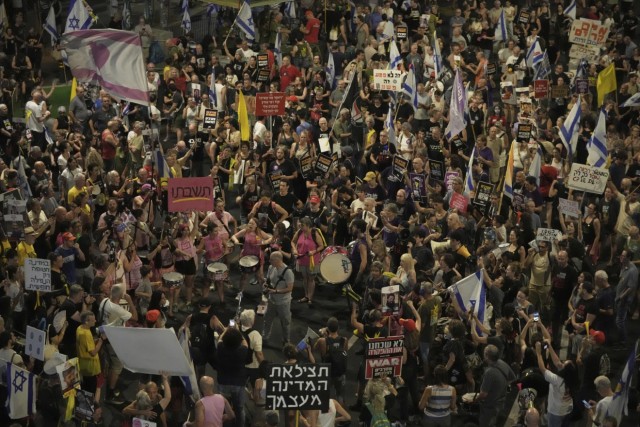
People take part in a protest demanding the end of the war, the immediate release of hostages held by Hamas in the Gaza Strip, and against Prime Minister Benjamin Netanyahu’s government in Tel Aviv, Saturday, Aug. 16, 2025.
Mass protests erupted across Israel on Sunday as citizens demanded a deal to release hostages held in Gaza. It marked one of the largest demonstrations in the 22-month-long war. Organizers said hundreds of thousands joined, blocking roads and gathering outside politicians’ homes.
Many Israelis are alarmed by reports of a new military offensive in Gaza’s most crowded areas. Families of hostages fear such moves could risk the lives of the remaining captives.
Yehuda Cohen, whose son is being held in Gaza, voiced the frustration: “We live between terrorists holding our children and a government refusing to free them.”
Even former Israeli military and intelligence chiefs are now calling for a negotiated deal.
Protesters Disrupt Daily Life
Demonstrators staged sit-ins near highways, lit bonfires, and shut down parts of major cities. Some restaurants and theaters closed in solidarity. Police reported 38 arrests.
For the first time, Israeli protesters carried images of starving Palestinian children. Such scenes, once rare, now reflect growing anger over humanitarian conditions in Gaza. The territory has seen over 250 malnutrition-related deaths since the war began.

Demonstrators block a road during a protest demanding the immediate release of hostages held by Hamas and calling for the Israeli government to reverse its decision to take over Gaza City and other areas in the Gaza Strip, near Jerusalem, Israel, Sunday, Aug. 17, 2025.
Netanyahu Rejects Calls for Ceasefire
Prime Minister Benjamin Netanyahu remains opposed to any truce that allows Hamas to remain in power.
“Ending the war without defeating Hamas only hardens their position and delays hostage releases,” he said. Netanyahu warned that such concessions could lead to a repeat of the October 7, 2023, Hamas attack, which killed about 1,200 people.
Far-right members of his coalition also pressured him. Finance Minister Bezalel Smotrich called the protests “a harmful campaign that plays into Hamas’ hands.”
The planned offensive would also require a new call-up of thousands of reservists, adding more strain to Israeli families.
Civilian Deaths Mount in Gaza
On the same day, at least 17 Palestinians were killed while waiting for aid trucks near the Morag corridor, according to hospitals. Witnesses claimed Israeli snipers fired into the crowds.
Hamza Asfour, waiting near the site, described the desperation: “It’s either risk death or watch my family starve.”
Separately, three people were killed in an Israeli airstrike on Bureij camp in central Gaza.
Gaza’s Health Ministry said the total death toll has now surpassed 61,900. Around half are reported to be women and children. On Sunday alone, two children and five adults died from malnutrition.
Israel disputes the ministry’s numbers but has not released its own figures. The UN, however, continues to treat the ministry’s data as the most reliable available.
Starvation Reaches Critical Levels
The United Nations warned that malnutrition in Gaza has reached the worst levels since the war began. Israel imposed a full blockade in March, stopping most aid deliveries. Although some supplies have resumed, aid groups say the amount is far below what is needed.
Designated “safe zones” have not guaranteed security, as they too have been bombed. Displaced Palestinians say there is no place left to go.
“There are no humanitarian zones at all,” said Raghda Abu Dhaher, now living in a crowded school after being displaced ten times.
Israel Plans New Gaza Offensive
The Israeli military has signaled preparations for another major ground offensive in Gaza City, Muwasi, and the so-called “central camps.” Plans also include forcing civilians to move south.
But many Palestinians refuse to leave. “Here is bombing and there is bombing,” said Mohamed Ahmed. “There is no safe place.”
Israeli Strikes Hit Yemen
Meanwhile, Israel expanded its military actions beyond Gaza. Airstrikes hit Yemen’s capital, targeting Houthi rebels backed by Iran.
The Houthis have fired missiles at Israel and attacked ships in the Red Sea since the war began. Israeli forces confirmed the strikes, saying they were in response to drone and missile launches.
Houthi media reported that a power plant in Sanhan was destroyed, knocking it out of service. Later, the Houthis claimed they targeted Israel’s Ben Gurion Airport, though Israel said it intercepted the attack.
The Road Ahead
The war shows no sign of ending soon. Protests in Israel are intensifying, families of hostages are desperate, and Palestinians continue to face extreme hunger and displacement. Netanyahu, however, insists on continuing the fight until Hamas is destroyed, leaving the nation divided and the conflict far from resolution.