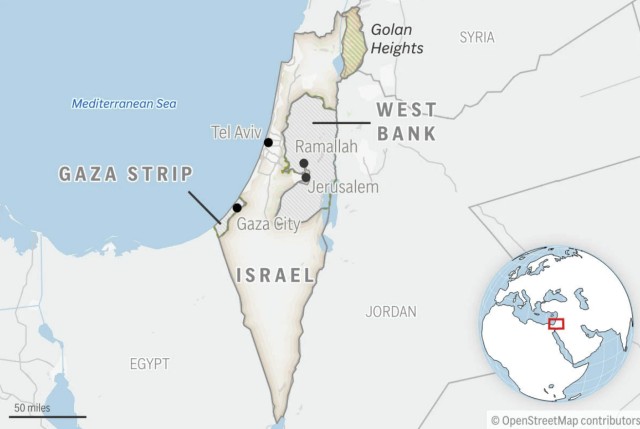
This is a locator map of Israel and Palestinian territories.
Israel’s Supreme Court has delivered a rare ruling against the government, declaring that Palestinian prisoners have been deprived of adequate food. The judges ordered authorities to improve both the quantity and quality of meals for detainees.
This judgment marks one of the few occasions where the judiciary has openly challenged the government during the ongoing Israel-Hamas war.
Court Finds Food Deprivation in Israeli Prisons
The case was brought forward by two Israeli human rights groups—Association for Civil Rights in Israel (ACRI) and Gisha. They accused the government of implementing a “systemic policy” of starving Palestinian detainees.
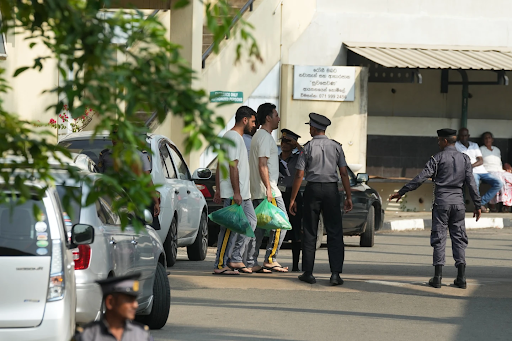
Thousands of Palestinians have been arrested in Gaza and the occupied West Bank since the Hamas attack on October 7, 2023. Many were detained without charges and later reported harsh conditions. Accounts include overcrowded cells, minimal food rations, poor medical attention, and disease outbreaks.
The three-judge panel ruled unanimously that Palestinian prisoners must receive three daily meals. The court stressed that this is essential to ensure “a basic level of existence” and ordered the government to comply.
“Not Luxury, But Survival”
In a strongly worded statement, the judges clarified that they were not advocating comfort or luxury. Instead, the ruling underlined the importance of survival standards mandated by law.
“We are not speaking here of comfortable living or luxury, but of the basic conditions of survival,” the court said. “Let us not share in the ways of our worst enemies.”
This ruling stands out as Israel’s judiciary rarely interferes with wartime policies. For nearly two years of conflict, the government has dismissed international criticism, insisting that harsh measures are necessary to defeat Hamas.
Deaths and Malnutrition Inside Prisons
Palestinian authorities report that at least 61 prisoners have died in Israeli custody since the war began. In March, a 17-year-old detainee reportedly died of starvation in an Israeli prison.
Human rights groups warn that food restrictions amount to deliberate neglect, pushing detainees toward malnutrition and starvation. ACRI called Israeli detention centers “torture camps” and urged immediate enforcement of the verdict.
“A state must not starve people,” ACRI wrote on social media. “People must not starve people—no matter what they have done.”
Political Backlash from Israeli Leadership
The decision triggered sharp criticism from Israel’s National Security Minister, Itamar Ben-Gvir. He oversees the prison system and has openly advocated for harsh conditions for Palestinian detainees.
Ben-Gvir claimed last year that he reduced living conditions to the bare minimum allowed by law. Following the ruling, he attacked the judges, asking sarcastically, “Are you from Israel?”
He argued that while Israeli hostages in Gaza suffer without international help, the Supreme Court is defending Hamas prisoners. He vowed to maintain his policy of providing prisoners with “the most minimal conditions stipulated by law,” despite the court’s order.
A Rare Act of Judicial Oversight
This case highlights a rare act of judicial restraint during wartime. Israel’s Supreme Court, often criticized for siding with government policies, has now reinforced that even prisoners have a legal right to food.
The ruling emphasizes that basic humanitarian standards cannot be ignored, even amid conflict. It raises pressing questions about Israel’s prison system and its accountability under both domestic and international law.
While the government’s response remains uncertain, human rights groups insist on immediate action. For now, the spotlight remains on whether Israel will comply with its highest court or continue its restrictive prison policies.